
| Origin | Okinawa, where local fighting methods blended over centuries with Chinese martial arts. Shotokan descends primarily from Shuri-te (and the related Tomari-te) — the lighter, faster, longer-range tradition. |
|---|---|
| Brought to Japan | By Gichin Funakoshi (1868–1957), an Okinawan schoolteacher who demonstrated karate in Tokyo in 1922 and stayed to teach it. |
| The Name | Shoto — "pine waves" — was Funakoshi's pen name, taken from the sound of wind through the pines near his home. His students called his dojo the Shotokan, "the house of Shoto." The hall's name became the style's. |
| The Word Karate | Funakoshi changed the written characters from "China hand" to "empty hand," aligning the art with Japanese budo. Karate-do: the way of the empty hand. |
| Guiding Mindset | Ikken hissatsu — "to finish with one blow." A mindset, not a literal promise: put everything into the technique in front of you. |
| Hallmarks | Deep, rooted stances; linear power in straight lines; kime — total focus at the instant a technique arrives. |
| The Canon | 26 canonical kata, beginning with the five Heian forms — with the founder's own Taikyoku kata and Ten no Kata practiced outside the canon. |
| Ranks | Kyu grades (colored belts) count down to 1st kyu; dan grades count up from 1st dan — shodan, literally "first step," not mastery. |
| Organizations | Taught worldwide through the Japan Karate Association (JKA), the Shotokan Karate-Do International Federation (SKIF), and many independent associations. |
Kihon (basics), kata (forms), kumite (partner work) — every class, anywhere in the world, is built from the same three components.
The formal syllabus the major organizations share and grade against — beginning with the five Heian kata, one new form per grade through the middle ranks.
Pre-arranged sparring, then semi-free, then free sparring (jiyu kumite) — techniques pulled short of full contact, because control is part of the skill.
Colored belts count down to 1st kyu (brown); black belt grades count up from shodan. Exact colors and order vary between organizations — the direction of travel does not.
Shotokan Karate: An Instructor's Overview
It's your third class. The instructor calls out in Japanese, the whole line steps forward into a deep front stance and punches. And you are half a beat behind, punching with the wrong hand, your stance a foot too short. The senior student next to you doesn't look annoyed. She just resets, glances at your feet, and shows you the turn one more time, slowly. Every Shotokan practitioner alive started exactly there: a half-step late, slightly embarrassed, and quietly determined to get it right. This guide is the map of the art you were standing in: where it came from, how it trains, and how its ranks, kata, and principles fit together.
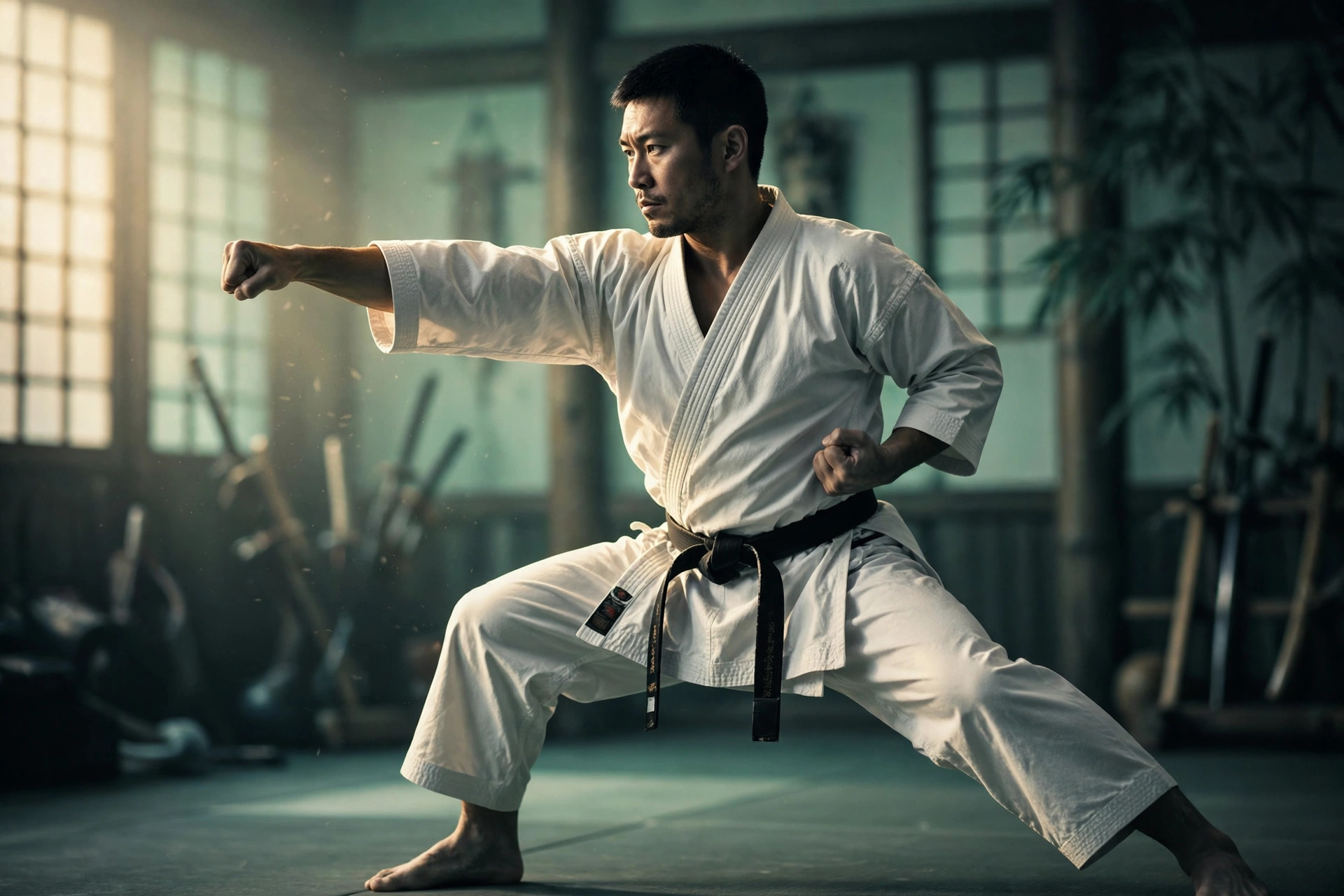
Shotokan is the most widely practiced style of karate in the world, and if you have ever seen a karate class, the white uniforms, the deep stances, the sharp linear punches, the loud kiai, there is a good chance you were looking at Shotokan. It is a traditional Japanese martial art built on three things: powerful basics, precise forms, and disciplined partner work. This guide covers where Shotokan came from, how it is trained, and what to expect if you decide to step onto the floor yourself.
- Shotokan Karate: An Instructor's OverviewIt's your third class. The instructor calls out in Japanese, the whole line steps forward into a deep front stance and…
- Shotokan Karate for Beginners: Your First 90 DaysOn your first night, you stand in the back row, because the back row feels safer. The instructor counts, ichi, ni, and…
- Shotokan vs Other Karate Styles: What's Actually Different?You move to a new town and visit the only karate dojo within driving distance. The uniforms look right. The bowing look…
- Mastering the Mae GeriYour front kick lands and nothing much happens. The pad holder barely moves. Worse, he steps in while your leg is still…
- Heian Shodan in DepthYou are halfway through the kata and the room has gone wrong. You turned, blocked, and punched, and now you are facing…
- Why Deep Stances Hurt, and How to Build a Stance That LastsHalfway down the line in kihon your front thigh is burning and your front knee has started to ache in a way that feels…
- Out of Range: The Distance Problem in KumiteYou step in for gyaku-zuki in jiyu kumite and your fist stops six inches short of your partner's chest. You stretch, le…
- What Is Kata For?You finish Heian Yondan without a mistake. Every turn lands. Both kiai land. Your instructor nods, and then a newer stu…
- All Arm, No Hip: Where Punching Power Actually Comes FromYour instructor watches one reverse punch and says what he said last month. Use your hips. So you throw the next one ha…
- The Flinch: Why You Close Your Eyes, and How Training Fixes ItIn line drills your block is clean. Your instructor has said so. Then kumite starts, your partner steps in with a punch…
- Everyone Sees Your Mawashi Geri ComingYou throw your roundhouse kick in kumite and your partner is simply not there anymore. He has stepped off, or raised a…
- The Side Kick That Hurts the Wrong LegHalfway through kihon, the call comes: yoko geri kekomi (side thrust kick), chudan (middle level). Your kick goes out,…
- Grading Day Nerves Are Not a Character FlawThree weeks before the grading, you are the steadiest student in the dojo. Your Heian Shodan is clean, your kihon lines…
- Shotokan Karate Quick Reference
- First 90 Days Training Plan & Progress Tracker
- Karate Style Comparison & School Chooser Checklist
- Mae Geri Training Guide
- Heian Shodan Practice Guide
- Stance Health and Mobility Reference
- Maai Training Playbook
- First Bunkai Workbook
- Power Mechanics Drill Book
- Contact Confidence Progression
- Mawashi Geri Mechanics Playbook
- Yoko Geri Playbook
- Grading Day System: The Four-Week Preparation for Passing Like You Train