
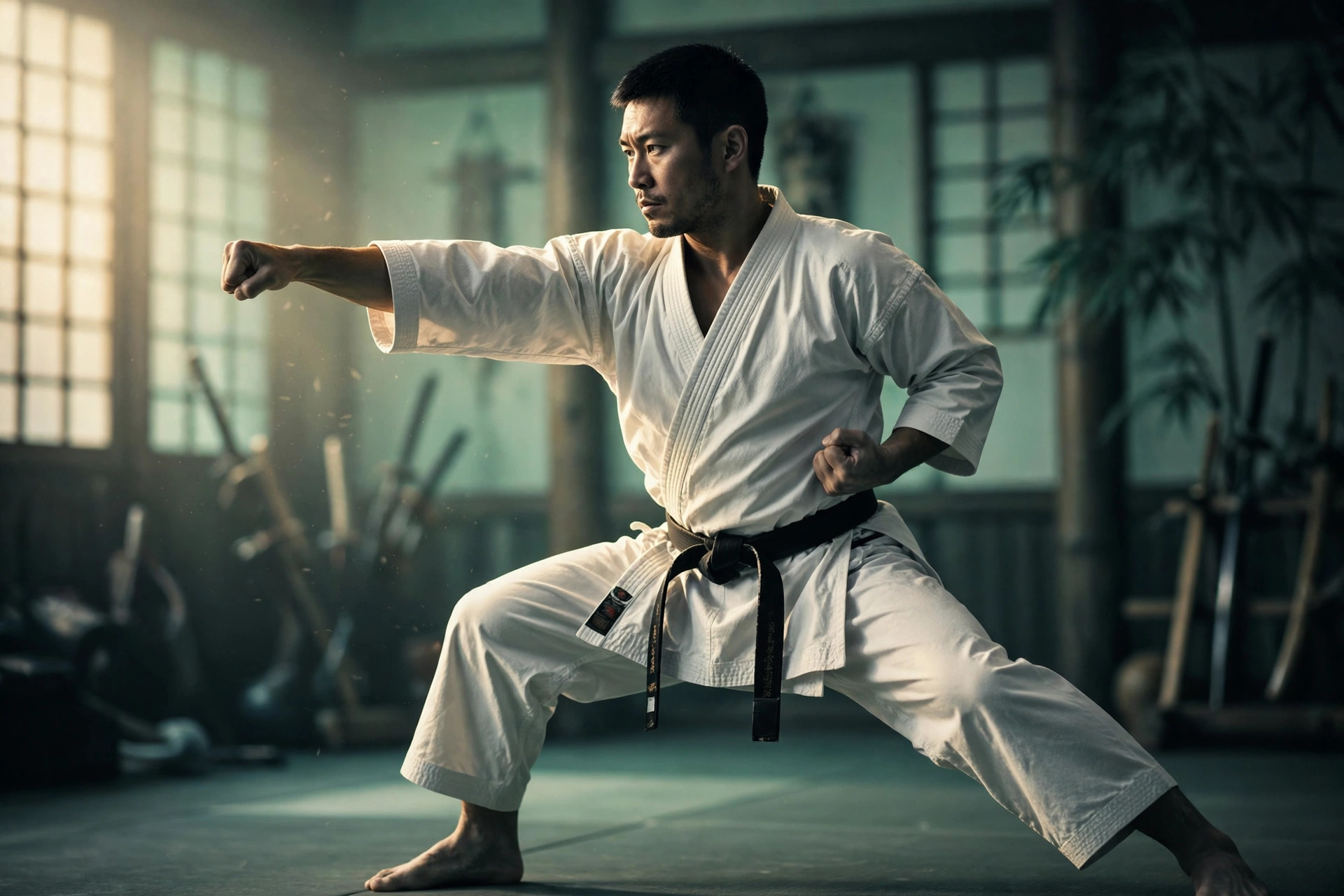
The senior student next to you doesn't look annoyed. She just resets, glances at your feet, and shows you the turn one more time, slowly. Every Shotokan practitioner alive started exactly there: a half-step late, slightly embarrassed, and quietly determined to get it right. This guide is the map of the art you were standing in: where it came from, how it trains, and how its ranks, kata, and principles fit together.
Shotokan is the most widely practiced style of karate in the world, and if you have ever seen a karate class, the white uniforms, the deep stances, the sharp linear punches, the loud kiai, there is a good chance you were looking at Shotokan. It is a traditional Japanese martial art built on three things: powerful basics, precise forms, and disciplined partner work. This guide covers where Shotokan came from, how it is trained, and what to expect if you decide to step onto the floor yourself.
Section 01What Shotokan Is
Shotokan is a style of karate-do, the Japanese "way of the empty hand." Its training emphasizes strong, linear techniques delivered from deep, stable stances. Punches, blocks, and kicks are drilled until they become fast, direct, and committed. The goal is not to throw a lot of techniques, but to make each one count.
That philosophy is often summed up in the phrase ikken hissatsu: "to finish with one blow." It is a mindset, not a literal promise. Shotokan training asks you to put everything into the technique in front of you rather than holding back for the next one.
Section 02Okinawan Roots, Japanese Form
Karate developed in Okinawa, where local fighting methods blended over centuries with Chinese martial arts. Two of the main Okinawan traditions were Shuri-te and Naha-te, named for the towns where they were practiced. Shotokan descends primarily from Shuri-te (and the related Tomari-te), which favored lighter, faster, longer-range movement compared with the heavy breathing and close-range methods of Naha-te.
The man who brought karate to mainland Japan was Gichin Funakoshi (1868–1957), an Okinawan schoolteacher who demonstrated karate in Tokyo in 1922 and stayed to teach it. Funakoshi studied under masters Yasutsune Itosu and Ankō Asato, and he is the reason karate is practiced the way it is today: he organized its teaching, gave it a grading structure borrowed from judo, and presented it as a method of personal development, a do, or way, rather than simply a fighting system.
The name Shotokan is not Funakoshi's own invention. Shoto ("pine waves") was his pen name, taken from the sound of wind moving through the pine trees near his home. His students called the dojo where he taught the Shotokan, literally, "the house of Shoto." The hall's name eventually became the style's name. Funakoshi is also credited with changing the written characters for karate from "China hand" to "empty hand," aligning the art with Zen-influenced Japanese budo and helping it gain acceptance in Japan.
Section 03The Three Pillars of Training
Every Shotokan class, anywhere in the world, is built from the same three components.
Kihon (basics). Kihon is the drilling of fundamental techniques: stances, punches, blocks, strikes, and kicks, performed solo in lines, over and over. This is where Shotokan's power is built. A beginner learns the front stance (zenkutsu dachi), the basic rising block (age uke), the lunge punch (oi-zuki), and the front kick (mae geri) in the first weeks, and a black belt still practices those same techniques decades later. Kihon's purpose is to make correct body mechanics automatic.
Kata (forms). Kata are pre-arranged sequences of techniques performed against imaginary opponents. They preserve the style's accumulated knowledge, its combinations, angles, and strategies, in a form you can practice alone. Kata training develops balance, breath control, timing, and focus, and it is the solo heart of the art.
Kumite (sparring). Kumite is partner work, and it is introduced in careful stages. Beginners start with pre-arranged sparring (kihon kumite), where the attack and defense are agreed in advance: one stepping attack, one block and counter. This progresses through semi-free sparring to free sparring (jiyu kumite), where both partners move and choose their techniques. In traditional Shotokan, kumite is controlled: techniques are pulled short of full contact, because the same technique trained to stop an inch away is trained to be decisive. Control is not a limitation of the training. It is part of the skill being trained.
Section 04The Kata: The Canon of 26 — and What Sits Outside It
Shotokan's formal kata canon contains 26 kata. That is the syllabus the major organizations share and grade against. But it is not the whole of what Shotokan students practice, and this section covers both: the canon in full, then the founder's own training forms that sit outside it.
Within the canon, students begin with the five Heian kata, Heian Shodan through Heian Godan, which were adapted by Itosu Anko from older forms as teaching kata for school students. They are short, build progressively, and introduce nearly all the fundamental stances and techniques. A student working steadily will typically learn one new kata per grade through the middle ranks.
| # | Kata | Series | Meaning / known for |
|---|---|---|---|
| 1 | Heian Shodan | Heian | "Peace and safety," level one, the first kata of the canon (many schools start beginners on Taikyoku Shodan first, see below) |
| 2 | Heian Nidan | Heian | Level two, introduces the side snap kick |
| 3 | Heian Sandan | Heian | Level three, close-range techniques from horse stance |
| 4 | Heian Yondan | Heian | Level four, slow opening movements, knee strike |
| 5 | Heian Godan | Heian | Level five, contains the Heian series' jump |
| 6 | Tekki Shodan | Tekki | "Iron horse," performed entirely in horse stance, moving sideways |
| 7 | Tekki Nidan | Tekki | Iron horse, level two |
| 8 | Tekki Sandan | Tekki | Iron horse, level three |
| 9 | Bassai Dai | Bassai | "To storm a fortress" (dai = major), a flagship power kata |
| 10 | Bassai Sho | Bassai | The minor (sho) version of Bassai |
| 11 | Kanku Dai | Kanku | "To view the sky" (major), the longest of the standard kata |
| 12 | Kanku Sho | Kanku | The minor version of Kanku |
| 13 | Empi | - | "Flight of the swallow," fast changes of level and direction (also spelled Enpi) |
| 14 | Jion | - | Named for the Jion temple, strong, flowing fundamentals |
| 15 | Gankaku | - | "Crane on a rock," built around the one-legged crane stance |
| 16 | Hangetsu | - | "Half moon," slow, breathing-focused, in half-moon stance |
| 17 | Jitte | - | "Ten hands," classically applied against a staff |
| 18 | Chinte | - | "Rare hands," preserves seldom-used hand techniques |
| 19 | Sochin | - | "Tranquil force," rooted in sochin stance |
| 20 | Meikyo | - | "Bright mirror," calm, polished movement, with a jump |
| 21 | Ji'in | - | "Temple grounds," companion form to Jion and Jitte |
| 22 | Gojushiho Dai | Gojushiho | "Fifty-four steps," major version |
| 23 | Gojushiho Sho | Gojushiho | "Fifty-four steps," minor version |
| 24 | Nijushiho | - | "Twenty-four steps," flowing, wave-like direction changes |
| 25 | Wankan | - | "King's crown," the shortest of the advanced kata |
| 26 | Unsu | - | "Cloud hands," the most acrobatic kata, with spinning techniques and a 360-degree jump |
Spellings vary slightly between organizations (Empi/Enpi, Ji'in/Jiin), and schools differ in which kata they emphasize and how details are performed, but the canon itself is shared across the Shotokan world.
Outside the Canon: Taikyoku and Ten no Kata
The 26 are the graded canon, but two sets of forms created by Funakoshi himself are practiced widely in Shotokan dojos without being counted among them.
Taikyoku Shodan, Nidan, and Sandan. The Taikyoku ("first cause") kata are deliberately simple introductory forms built from the most basic techniques: Shodan combines the downward block and the lunge punch along a simple floor pattern, and Nidan and Sandan substitute other basic blocks and strikes. Their job is to give a brand-new student a complete kata that can be learned in the first weeks, before the Heian series begins. Many schools therefore teach Taikyoku Shodan as the true first kata. Others begin directly with Heian Shodan. Both are normal, and both are traditional.
Ten no Kata. The "kata of heaven," also created by Funakoshi, exists in two halves: Omote, a solo form stringing the fundamental blocks, strikes, and kicks together in a straight line, and Ura, the same techniques practiced with a partner as basic kumite. It was designed as the bridge between kihon and kumite: the fundamentals performed as a form, then applied against a person.
Some organizations add forms beyond even these. The Junro kata (Junro Shodan through Godan), created by Tetsuhiko Asai, are standard curriculum in JKS-line schools, for example. The pattern to understand is that Shotokan has a shared canon and a wider practiced curriculum. And a school teaching Taikyoku or Ten no Kata is not departing from tradition. It is teaching the founder's own training forms.
Section 05Belts: Kyu and Dan
Shotokan uses the kyu/dan ranking system. Students below black belt hold kyu grades, which usually run from 9th or 10th kyu (white belt) up to 1st kyu (brown belt). Colored belts mark progress through the kyu grades, though the exact colors and order vary between organizations and schools. Promotions are earned at formal gradings, where students demonstrate kihon, kata, and kumite appropriate to their level.
A representative ladder looks like this:
| Grade | Belt | Notes |
|---|---|---|
| 10th kyu | White | Beginner (some organizations start at 9th kyu) |
| 9th kyu | Yellow | |
| 8th kyu | Orange | |
| 7th kyu | Green | |
| 6th kyu | Blue | |
| 5th kyu | Purple | |
| 4th kyu | Brown | |
| 3rd kyu | Brown | |
| 2nd kyu | Brown | |
| 1st kyu | Brown | The final grade before black belt |
| 1st dan (shodan) | Black | Literally "first step" |
| 2nd dan (nidan) | Black | |
| 3rd dan (sandan) | Black | |
| 4th dan (yondan) | Black | |
| 5th dan (godan) | Black | Higher dan grades continue, up to 10th dan in most organizations |
Treat the table as a map, not a law: many schools insert intermediate grades (an "advanced" step or a stripe between colored belts), some use fewer kyu grades, and belt colors differ. A green belt in one organization may sit where a blue belt sits in another. What does not vary is the direction of travel: kyu grades count down to 1st kyu, then dan grades count up.
Black belt grades are dan ranks, from 1st dan (shodan) upward. A common misunderstanding is that black belt means mastery. In Shotokan, shodan literally means "first step": reaching it means you have learned the basics well enough to begin serious study. Higher dan grades involve longer minimum intervals between promotions, technical contribution, and teaching. Exact requirements differ by organization.
Section 06Training Principles
A few principles run through everything Shotokan does:
- Deep, rooted stances. Shotokan stances are longer and lower than those of most other karate styles. This builds leg strength and teaches you to generate power from the floor through the hips.
- Linear power. Techniques travel in straight lines, with the whole body behind them: hip rotation, a straight path, and full commitment of body weight.
- Kime. Kime is the instant of focus at the end of a technique: the whole body tenses briefly, breath is expelled (sometimes with a kiai), and the technique "arrives" all at once rather than drifting to its target.
- Distance and timing. Because techniques are long-range, Shotokan practitioners work hard on maai, managing the distance so a single stepping technique closes the gap completely.
Section 07The Dojo Kun and the Twenty Precepts
Shotokan is explicit that technique is only half the training. At the end of class, many dojos recite the Dojo Kun, five short principles traditionally attributed to the Okinawan master Sakugawa and passed down through Funakoshi's teaching:
- Seek perfection of character
- Be faithful
- Endeavor (put maximum effort into everything you do)
- Respect others
- Refrain from violent behavior
Each line is traditionally prefaced with hitotsu, "one" or "first," meaning each principle stands on its own as a complete instruction, and students are expected to repeat the kun with the understanding that it applies outside the dojo at least as much as inside it.
Funakoshi also left the Niju Kun, twenty guiding precepts for karate practice. Among the best known: "Karate begins and ends with courtesy," "There is no first attack in karate" (karate ni sente nashi, karate is a defensive art, never an excuse to start a fight), "Karate is like boiling water: if you do not keep the fire going, it turns cold," and the reminder that spirit comes before technique. Schools vary in how formally they teach the precepts, but the philosophy behind them, that the point of training is the person it produces, is common to the whole style.
Section 08Shotokan Today
Shotokan is taught worldwide through several major organizations, including the Japan Karate Association (JKA), the Shotokan Karate-Do International Federation (SKIF), and many independent associations. The style split into different organizations after Funakoshi's death, and while technical details vary, the core syllabus and training method are recognizably the same everywhere.
Shotokan is also the most common background of competitors in World Karate Federation (WKF) sport karate, which brought kata and point-fighting kumite to a global audience, including the Tokyo 2020 Olympics, where karate made its debut. Sport success is not the goal of traditional training, but the same fundamentals underpin both.
Section 09Where Students Go Wrong
The same handful of mistakes shows up in every dojo:
- Treating kihon as the warm-up. The line drills are not preparation for the real training. They are the real training. Students who coast through basics and save their effort for kata wonder why their kata has no power.
- Collecting kata instead of learning them. Memorizing the steps of a new form feels like progress. It is not, until the form you already know has correct stances, timing, and intent behind every move. One kata understood beats five kata recited.
- Punching with the arm. Beginners push the fist out with the shoulder. Shotokan power comes from the floor, through the legs and hips, with the arm as the last link. Until the hips drive the technique, it will feel weak no matter how hard you try, because effort is being spent in the wrong place.
- Staying tense the whole way through. Kime is a moment, not a condition. A technique that is tense from start to finish is slow. Power is relaxation in transit and total focus only at the instant of arrival.
- Treating black belt as the finish line. Shodan means "first step." Students who train toward black belt as a destination often quit shortly after reaching it. Students who understand it as a starting point keep going for decades.
- Arguing about which organization's version is "real." Details vary between the JKA, SKIF, and independent schools. The variation is normal and historical. Pick a school, learn its way thoroughly, and let the argument go.
Section 10Who Shotokan Is For — and What You Need to Start
Shotokan suits people who like structure. The syllabus is clear, progress is measurable, and the training rewards patience and repetition. It is practiced by children and adults well into old age. Intensity scales with the student. You do not need to be fit or flexible to begin. The training itself builds those qualities, gradually.
To start, you need almost nothing: most schools offer a trial lesson in ordinary training clothes. Once you enroll, you will need a gi (the white uniform) and a belt, which the school will supply or direct you to. Then it is simply a matter of showing up, twice a week, and letting the basics accumulate. Related: Shotokan Karate for Beginners: Your First 90 Days
Section 11The Companion Guide
This article gives you the knowledge. The companion guide turns it into something you can train with. The Shotokan Karate Quick Reference is a printable one-stop sheet containing everything in this article in lookup form: the complete belt ladder from white belt to the dan grades, all 26 canonical kata in a single table with their series and meanings plus the Taikyoku and Ten no Kata forms practiced outside the canon, a glossary of the core Japanese terminology (kihon, kata, kumite, kime, the common commands, and the words behind the Dojo Kun), the five Dojo Kun principles, and a short summary of the three pillars of training. It now runs to reference-manual depth: a kata annex writes out the beginner kata movement by movement and maps every advanced kata by floor pattern, principal techniques, and training theme, and a per-grade syllabus shows what is typically tested at each kyu grade. The standard gohon and kihon ippon kumite sets are listed attack by attack, and the glossary now covers the full working vocabulary of the dojo, over a hundred terms.
It is made for students who want the reference on paper, in the training bag, on the dojo wall, or at the front of a notebook, instead of searching an article mid-practice, and for anyone comparing schools who wants the standard syllabus in hand while they ask questions.
- Shotokan is a traditional Japanese karate style descending from Okinawan Shuri-te, brought to Japan by Gichin Funakoshi in 1922.
- The name comes from Shoto, Funakoshi's pen name: Shotokan means "the house of Shoto."
- Training rests on three pillars: kihon (basics), kata (forms), and kumite (partner work).
- The formal syllabus contains 26 canonical kata, beginning with the five Heian forms, and the practiced curriculum is wider, including Funakoshi's Taikyoku kata and Ten no Kata.
- Rank progresses through kyu grades (colored belts) to dan grades (black belt). Shodan means "first step," not mastery.
- Its hallmarks are deep stances, linear power, kime (total focus at the moment of impact), and the ikken hissatsu mindset of committing fully to each technique.