
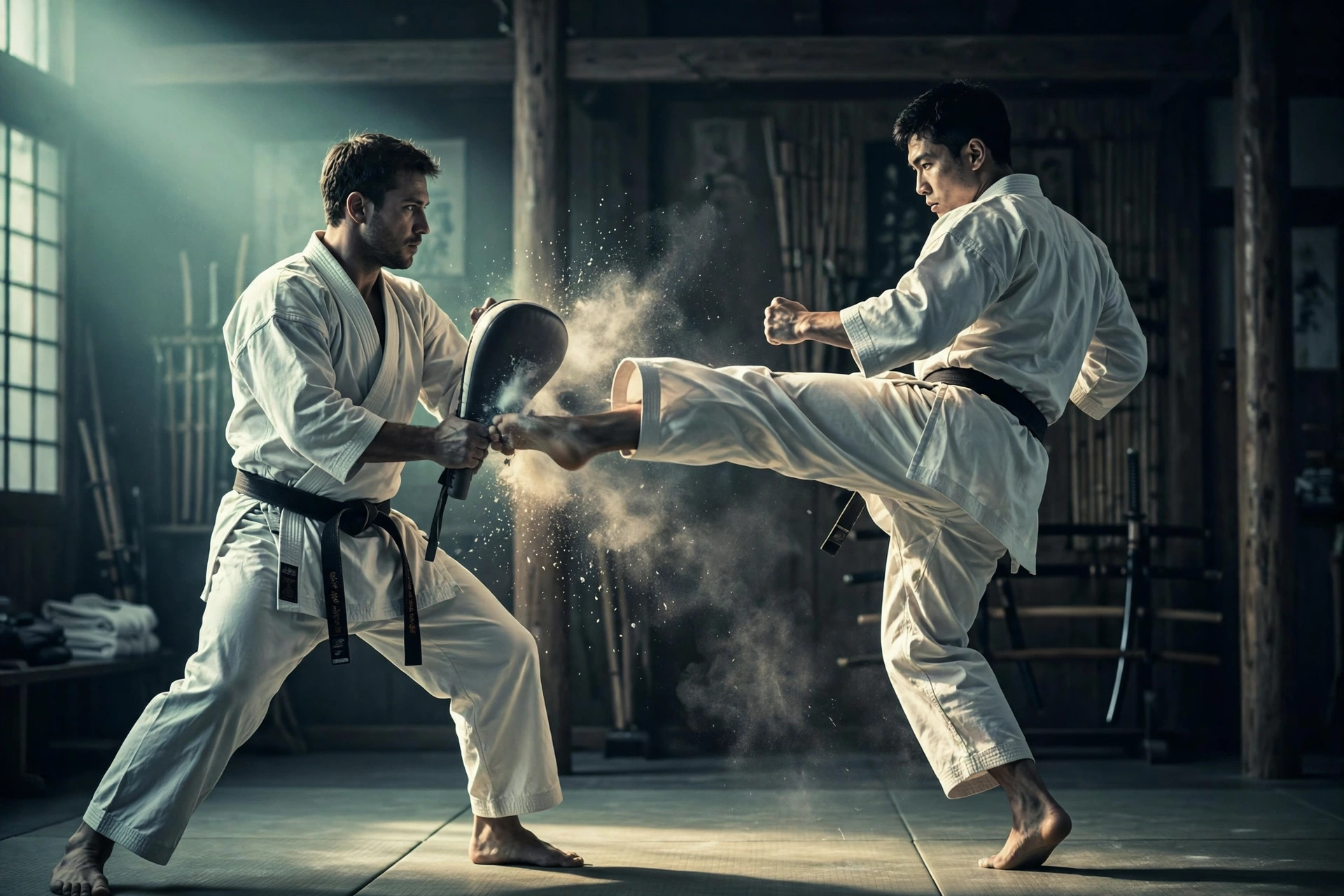
In the line drills your mae geri looks fine. Against a person it feels slow, weak, and easy to catch. That gap is not a talent problem. It is a mechanics problem, and mechanics can be fixed one part at a time. This article takes the front kick apart, piece by piece, and puts it back together at the depth the kick actually deserves.
Section 01The First Kick You Learn, and the Last One You Finish Learning
Mae geri is a fundamental technique. That word gets misunderstood. A fundamental is not a beginner technique you graduate from and leave behind. It is a load-bearing one. The whole structure of Shotokan kicking rests on the front kick's machinery, and the machinery is simple enough to state in one breath: the knee folds up, the leg extends, the leg folds back. Mawashi geri adds a turn of the hip to that machinery. Yoko geri changes its direction and its striking surface. Ushiro geri turns the whole body away and drives the leg backward. A student who owns the mae geri owns the chassis every other kick is built on.
This is why the kick is taught first, in place, by count, from the earliest grades, and why it is still being drilled in place, by count, by students with decades in the art. There is nowhere to hide in it. A roundhouse kick can borrow power from its swing, a spinning kick drama from the turn. The front kick has nothing to borrow. Balance, hip mobility, supporting leg strength, relaxation, timing, nerve: all of it shows up inside one second of plain movement. The kick is a diagnostic as much as a weapon.
So what separates a basic kick from a mastered one? Not the shape. The mastered kick has the same parts as the white belt's kick, in the same order. The difference is everything that has been removed. The basic kick goes up, out, and down, and hits something. The mastered kick starts from stillness with no dip, hop, or lean to warn the partner. Its chamber is already at full height before the partner has registered that a kick exists. It lands on the exact point chosen, at the moment the partner's weight commits, and it is home again before the partner's counter starts. It looks the same at repetition forty as at repetition one, on the tired leg, inside a combination, at the height the situation asks for.
Listen to the questions change as students improve. The beginner asks how to make the kick stronger. The advanced student asks how to take things out of it. At white belt the kick teaches you to stand on one leg. At brown belt it teaches you to combine. At black belt it teaches you about timing, distance, and your own habits, and it is still not finished with you.
Section 02Three Principles: Simplicity, Efficiency, Precision
Simplicity comes first because the kick itself is simple, and the student keeps trying to decorate it. One leg folds, extends, and folds back on a straight line. Every addition a student bolts on, a preliminary hop, a swing of the arms, a lean to gain height, a preparatory crouch, makes the technique worse, not better. The shortest technique is the hardest one to defend, and plain movement fails in fewer ways than fancy movement.
Efficiency is simplicity applied to energy. Nothing moves that does not need to move. The supporting foot stays planted. The hands stay at their posts. The head stays level. Force travels from the floor, up the supporting leg, through the hips, and out the kicking leg on the shortest route the body has. Any motion outside that route is energy spent on decoration, and it is usually worse than wasted, because stray motion also warns the partner or bends the line of force. The beginner spreads the same work across a full second of visible effort and calls the effort power.
Precision closes the set. Mae geri lands with a striking surface roughly the size of the front of your fist, and it has to arrive on a chosen point, at a chosen moment, while both people are moving. Precision is spatial, the ball of the foot on the target rather than near it. It is also temporal, contact made at the instant the partner cannot step away from it. And precision governs the kick's size. The kick extends as far as the target requires and no farther, because every extra inch past the ideal contact point is time spent recovering from your own technique. Unnecessary movement is not harmless. It is where counters live.
Section 03What Mae Geri Is
Mae geri means front kick. Mae is front, and geri is the spoken form of keri, kick. It is the first kick most Shotokan students learn and the kick they will throw more often than any other for the rest of their training. It strikes with the koshi, the ball of the foot, toes pulled back so the ball leads and the toes stay out of harm's way. The kick travels in a straight line from the floor to the target. No arc, no swing. That directness is the whole point: the front kick is the shortest route between your stance and the other person's midsection, and it arrives before most blocks are ready for it.
Shotokan teaches two deliveries of the same kick:
| Delivery | Name | How it works | Where you meet it first |
|---|---|---|---|
| Snap | Mae geri keage | The lower leg whips out and snaps straight back to the chamber | Stationary basics and most kihon lines |
| Thrust | Mae geri kekomi | The hips drive through the target as the leg extends, with less snap and more push | Stepping combinations and kumite, once the snap is reliable |
In the classical basics the snap is the foundation, and the thrust is built on top of it later. A thrust without a clean chamber is just a shove with a leg.
Section 04The Striking Surface: Why the Ball of the Foot
Every student asks it eventually, usually while rubbing a jammed toe: why the ball of the foot? The heel is bigger, harder, and already famous as a striking surface in other kicks. Why not kick with it? The answer is mechanical, and it comes in three parts.
Reach. Point the foot at extension, toes pulled back and ankle straightened, and the ball of the foot sits at the very end of the leg's full length. The foot itself becomes the last segment of the kick. Strike with the heel instead and the geometry collapses: the foot has to flex upward, toes pointing back toward your own shin, and everything past the ankle folds out of the line. You hand back several inches of leg. Giving away the length of your own foot, on the one technique whose job is reach, makes no sense.
Force on a small surface. Pressure is force divided by area. The same drive from the same leg can spread itself across the flat underside of a whole foot, or it can arrive through the koshi, the padded ball at the base of the toes, backed by the heads of the metatarsal bones. The first version pushes. The second version penetrates. A kick that lands on the whole sole tends to slide up the target and spend itself. A kick that lands on the ball goes in.
The ankle and the toes. The foot changes shape twice in one kick. In the chamber the toes pull back hard, drawing the ball forward and exposing it. At extension the ankle straightens at the last moment so the ball points into the target instead of scraping up it. The toe pull does two jobs at once. It presents the striking surface, and it gets the toes out of the impact. Toes that are not pulled back strike first. They jam against the target, bend backward, and can break, and the force of the kick leaks away into the toe joints instead of running cleanly up the shin. The ankle matters just as much. At contact it must be firm. A loose ankle folds on impact, spills the force sideways, and risks a sprain. The shape is not decoration. It is the difference between a leg that ends in a weapon and a leg that ends in a hinge.
Where the heel belongs. None of this demotes the heel. It has its own kicks, and in them it is the correct surface because the leg's line of force runs through it. Ushiro geri, the back kick, strikes with the kakato, the heel, because the leg drives straight backward and the heel is the end of that line. Fumikomi, the stamping kick, comes down with the heel and the edge of the foot onto a knee, a shin, or a foot. Yoko geri kekomi, the side thrust kick, makes contact with the blade edge of the foot, sokuto, but the drive behind it runs through the heel. An older JKA instructor's manual even lists the heel as a thrusting surface against low targets such as the thigh. The heel is a fine weapon when the geometry points through it. In a front kick it does not, so the front kick uses the ball. That is not dogma. It is carpentry: the surface follows the line of the force.
Section 05Keage and Kekomi: The Snap and the Thrust
Mae geri keage, the front snap kick. Once the knee reaches its chamber height, the thigh largely stays where it is and the action moves to the knee joint. The lower leg whips out, the foot meets the target, and the same whip brings it straight back. The hips contribute a small forward push driven by the supporting leg, but they do not travel. Retraction is not a separate phase of the keage. It is the second half of one motion, and it should be as fast as the extension. The lead leg version, kizami mae geri, is the stop kick of kumite precisely because the snap asks so little of the body: no travel, no commitment, the leg out and back while your stance barely changes. Ren-geri, the double kick, is two snap kicks off one chamber, which is only possible because the first kick comes home instead of landing.
Mae geri kekomi, the front thrust kick. Here the chamber is only the loading position. Extension is driven by the whole leg and the body behind it: the supporting leg presses the floor away, the hips translate forward toward the target, and the kicking hip comes through as the knee extends, so the thigh travels rather than staying home. Contact lasts longer than the snap's touch. The foot arrives and keeps arriving, and a partner on the receiving end is moved backward, not just stung. Retraction is slower and more deliberate, and the kekomi often does not retract to the starting stance at all: the foot sets down forward, because the body has arrived where the kick went. This is the kick for stopping a heavier advance and for driving a partner off you and taking their ground. It costs more than the snap: more travel, more commitment, a longer recovery if it misses.
| Keage, snap | Kekomi, thrust | |
|---|---|---|
| Trajectory | Short, straight, out and back on one line | One long line through the target |
| Hip action | Hips stay home, small push from the supporting leg | Hips translate forward, kicking hip drives through |
| Contact | Brief, a crack of contact | Longer, pushes the target back |
| Retraction | Immediate, part of the same motion | Deliberate, foot often sets down forward |
| Cost when it misses | Low, stance barely disturbed | Higher, body has committed forward |
| Choose it when | Speed, recovery, a follow-up technique, repeated kicks, the lead leg stop kick | Stopping power, moving a partner backward, taking ground, a finishing drive |
Choosing between them is a reading of the moment, not a preference. A partner advancing quickly but lightly gets the snap, because you need your leg back before their next step. A partner who must be moved, or who is walking through your snap kicks, gets the thrust. A combination that continues into a punch wants the snap, whose recoil feeds the landing the punch needs. A kick thrown to end an exchange and reclaim distance wants the thrust. And in the basics none of this matters until the snap is reliable, which is why progressions introduce the thrust late and instructor led.
Section 06Stance, Posture, and Structural Alignment
The kick does not happen in the air. It happens inside a stance, and the stance decides what the kick can be. In the basics that stance is usually zenkutsu dachi, front stance. In kumite it is your fighting posture. Either way, a chain of alignment has to hold from the floor to the target: supporting foot planted, supporting knee tracking over that foot, hips level and square, spine vertical, head level, eyes on the target. And balance runs through all three phases: center settled over your base before the kick, passing over the supporting foot during it, and a landing that is a position you could freeze in, not a recovery.
Posture is the visible part of alignment. Stand tall through the crown of the head. Chin in, shoulders down and level, back straight, stomach braced lightly rather than held rigid. Leaning back moves the hips, the engine of the kick, away from the target, and the leg arrives lighter and shorter than it should. It can look deceptively correct, because driving the hips forward leaves the head and shoulders behind them, and from the side a good kekomi can resemble a lean. The difference is direction: in the lean, the whole body retreats. In the drive, the hips advance and the upper body simply stays where it was. Leaning forward is the opposite cheat. It brings the face toward the counter, tips the center past the supporting foot, and turns the kick into a fall with a leg in front of it.
At the moment of contact, alignment becomes a single line of force: supporting foot, supporting knee, hip, thigh, shin, ball of the foot, target. If that line kinks at the waist or twists at the shoulder, the force leaks out through the kink. Much of what instructors call a weak kick is a strong leg attached to a bent line.
Section 07The Supporting Foot and Leg
Ask experienced instructors which leg makes the front kick and many will name the one that never leaves the floor. The supporting leg is the foundation, the spring, and the engine, all at once.
The whole foot stays on the floor. Heel down, sole planted, toes pointing at the target. This is the mainstream Shotokan basic and it is what the JKA instructor tradition teaches: the supporting foot is firmly planted and does not move, and both feet, knees, and toes point toward the target. The reasons are mechanical. A flat foot gives the leg its full contact patch with the floor, and the force you press into the floor comes back up the same leg. Rise onto the ball of the supporting foot and the foundation becomes a hinge, and part of every drive is spent on not falling over.
Then there is the pivot question, and it deserves an honest answer rather than a slogan. In mae geri keage the supporting foot does not pivot. It faces the target at the start and at contact, and a grading examiner in a JKA-line school is watching for exactly that. In kekomi, schools divide. Some teach the thrust with the foot planted the same way and let the hips do all the travelling. Others allow the supporting foot to turn slightly outward as the hips drive through, accepting a small turn in exchange for hip travel. If your school teaches the small pivot, it belongs to the thrust, as a controlled part of the drive. What it never is, in either delivery, is a scoop or a spin under the kick, or a habit that creeps into the snap.
The supporting knee is softly bent and points the same way as the toes. That bend is not slackness. It is the spring of the technique. It drops your center slightly, loads the leg, and gives the hip drive somewhere to come from. Lock the supporting knee and the leg becomes a pole. The kick rides up instead of driving forward, balance turns brittle, and every landing shock goes straight into the joint. Let the knee cave inward and the line of force bends at its base, with the same leak and a worse bill for the knee itself.
Driving off the floor is the supporting leg's main job. At the moment of extension, press the floor away from you. The push travels up the supporting leg, moves the hips forward, and leaves through the kicking foot. After contact, the same leg absorbs the recoil and holds the center in place while the kicking leg comes home.
Section 08The Chamber: Where the Kick Is Aimed
The chamber is the loaded position the kick fires from: thigh raised, knee bent fully, heel drawn in close toward the thigh, the shin folded under, and the foot already shaped with the toes pulled back. It is the kick, aimed and cocked, and most of the kick's quality is decided before the foot ever extends.
Height first. The working rule is that the knee must reach at least the height the foot is meant to strike, because the foot extends from the knee, travelling level or very slightly down. A foot asked to climb above its own knee turns the kick into an upward scoop: slow, weak at the top, and plainly visible. This is why chamber standards are set at belt height or higher for a chudan kick. If the target rises, the knee rises first.
The angle and path of the lift matter as much. The knee rises close to the body's center line, brushing past the supporting knee, with the heel tracking under the thigh. It does not swing out to the side. A knee that flares wide on the way up announces the kick to anyone watching, lengthens the foot's path to the target, and quietly converts a front kick toward a roundhouse shape. The straight, close lift is also the faster one: the knee travels the shortest distance from stance to chamber, and the foot behind it is already on the line it will extend along.
Most important of all: the knee points at the target. Instructors have said it for generations, aim the knee and the foot will follow. The chamber is the kick's sighting mechanism. If the knee points a hand's width left of the target, no cleverness in the lower leg will fully rescue the line. The foot shape belongs to the chamber too. Toes pulled back and ankle set while the knee is still rising means the striking surface arrives finished. Students who shape the foot during extension waste the fastest part of the kick on housekeeping, and often arrive with the toes still leading.
The chamber faults are worth naming plainly. A low knee, which caps the kick's height and forces the scoop. A wide knee, which telegraphs and bends the line. A loose fold, heel hanging far from the thigh, which makes the leg a pendulum instead of a folded spring. A dangling, unshaped foot. And the subtlest one: a chamber reached by leaning back, where the knee's height was bought by tipping the body, and the kick that follows has no hips left to drive it.
Section 09Retraction: Hikiashi, the Forgotten Half
Hikiashi is the pulling back of the kicking foot, and it is the part of the mae geri students most often leave untrained. The kick goes out with intent and comes back as an afterthought, dropping toward the floor or drifting home at half speed. Watch a class and you can grade the students by their returns alone. The manual tradition knows it: the JKA instructor's manual assigns the motion a ratio of three parts kicking out to seven parts pulling back. The return is not the rest between kicks. It is the larger share of the skill.
The mechanics are plain. The foot retraces the line it took out, at a speed at least equal to the extension. The knee stays high while the shin refolds, so the leg comes back into the chamber rather than collapsing under itself, and only then does the foot set down or the next technique begin. A recoil that cuts the corner or lets the knee fall produces a leg that arrives home low and late, in no position to do anything.
Why does it matter so much? Start with your own leg's safety. A leg left extended is a handle. A partner who catches it owns your balance, and the counters are unkind: the leg is swept, or the partner steps inside the dead zone beyond your foot and hits you while you stand on one leg with the other one occupied. The fast recoil is what makes the front kick hard to punish, and it is most of what instructors mean when they call a kick clean. Retraction also protects your own knee. A controlled extension ends with the hamstrings braking the shin and the leg folding straight back under muscular command. A lazy kick ends by locking the joint straight or swinging down uncontrolled, and repeated hundreds of times in the air, that is how knees get sore in the name of practice.
Then there is what the recoil makes possible. Nearly every combination in Shotokan assumes the leg comes home or lands ready. Ren-geri is a recoil that never touches the floor: the first kick refolds into a chamber and fires again. The reverse punch that lands as Heian Nidan's front kicks finish works because the recoil and the set down are one motion, pouring the body's arrival into the punch. Train the return as its own part, at its own speed, and the whole kick changes character: it stops being a poke and becomes a tool you can use twice.
Section 10The Upper Body: Quiet Hands, Level Shoulders
The upper body has one job during a front kick, which is to not participate. Beginners find this genuinely difficult. The body wants to seesaw: leg forward, arms backward, as if the kick needed a counterweight thrown the other way. It does not. Your center stays over the supporting leg because your posture holds it there, not because your arms swung at the problem, and swinging arms cost you three things at once: they open the head and chest, they twist the shoulders and bend the kick's line with them, and they announce the kick before the knee has moved.
The guard hand stays at its post, covering the face, for the entire kick. In formal line basics the hands follow the kamae the drill sets, which in the elementary forms often means fists held at the hips, ready for the punches the line is built around. In fighting posture the hands stay up in guard. The setting changes. The rule does not. Hands are placed, never swung. Where a pull-back does appear, it is small and structural: as the kicking hip drives forward in the thrust, the same-side shoulder stays back and down, keeping the torso square. The moment the chest twists to help, the hips twist with it, and some of the drive leaves through the rotation instead of reaching the foot.
Shoulders carry the telegraphing problem. A shoulder that rises, dips, or rolls before the kick is the loudest announcement a technique can make, louder than any foot movement, because eyes track the upper body. Level, lowered shoulders over a quiet chest are what a still start actually looks like. The head finishes the picture: eyes on the target from the first instant to the last, chin level, no dipping down to admire your own foot.
Section 11The Biomechanics: Where Power and Speed Actually Come From
Take the kick apart by joints and a clear division of labor appears.
The lift belongs to the hip flexors, mainly the iliopsoas and the rectus femoris, which raise the thigh into the chamber. These are quick, comparatively small muscles, and their job is positioning. They contribute almost nothing to the impact, which is why trying to make a kick powerful by lifting harder produces a bigger chamber and the same soft contact.
The extension belongs to the quadriceps, which straighten the knee. The lower leg is a light lever and the foot sits at the far end of the longest lever in the body, so knee extension is fast and the foot's speed multiplies along the leg.
The drive is where power actually lives, and it is body mass in motion. The supporting leg presses the floor, the hips translate forward toward the target, and in the thrust the kicking side of the hip drives ahead as the knee extends, so thigh, body weight, and floor pressure arrive at the contact together. The force path runs unbroken: floor, supporting leg, pelvis, thigh, shin, ball of the foot. Students hunting for power usually search in the kicking leg, because that is the part they can see. The kicking leg mostly delivers what the floor and the hips provide.
Speed has a less obvious source: relaxation. A muscle and its opposite cannot both work at full effort, so a leg that travels tense is braking itself the whole way, hamstrings resisting the quadriceps, hip muscles fighting the lift. The fast leg travels loose and tightens only at the end. This produces the paradox every experienced student recognizes, that the mastered kick looks effortless. The master's work is real but it is concentrated into the floor pressure and a fraction of a second at contact, so from across the room the kick reads as quiet, almost casual, right up until the pad sounds.
Balance is placement, not stillness. Your center of mass has to stay over the supporting foot while everything moves. The tighter and shorter the center's own path, the fewer corrections the body must make, and corrections are what wobble looks like. A kick thrown with the center drifting needs a rescue on landing. A kick thrown with the center placed needs none. That is why experienced students can kick from postures that would put a beginner on the floor: not stronger ankles, a quieter center.
Section 12Kime: Tension With a Timestamp
Kime is the total focus of the body at the decisive moment: every relevant muscle engaging together for a fraction of a second at contact, the breath driven out and checked, the whole structure committed behind the striking surface. Then, immediately, release. The release is part of kime, not a failure of it. A leg held tense after contact cannot recoil, and a body held tense between techniques moves at the speed of its own stiffness.
Kime mistimed in either direction ruins the kick. Arrive tense too early and the leg travels stiff and slow, pushing at the target with a rigid lever. Stay loose too long and contact is a touch, the foot meeting the target while the body behind it is still deciding. The skill is a leg that travels relaxed and becomes total for one instant. In the snap kick the kime is a crack, the briefest possible contraction matched to the briefest contact. In the thrust it is heavier and a shade longer, pressure sustained while the hips complete their travel.
There is a mental layer instructors point at with the same word. Kime is also the decision made once and completely. A kick thrown at ninety percent commitment, with a private reservation, is slower than the same kick thrown whole. Part of what long practice builds is not a stronger leg but an undivided instant.
Section 13Timing and Distance: When the Kick Happens
A technically perfect kick thrown at the wrong moment is a miss with good form. Mae geri owns the far edge of maai, the fighting distance, because it is longer than any punch your partner owns. At correct distance the foot arrives with the hips behind it and a small bend still in the knee, the structure complete. One step too far and the kick becomes a reach: the chin comes forward, a hop creeps in, the support leg straightens early, and the foot arrives alone. One step too close and the chamber jams against the partner's advance, with no room for the knee to lift. Distance is half the technique, and it can be measured and learned like any other part.
Timing builds on distance. The kick wants the moments when the partner cannot leave: as their step lands and their weight commits forward, as their own technique finishes and their guard is occupied, as they breathe and reset. The rear leg kick covers the most ground and hits hardest, but takes the longest to arrive, so it wants a committed or stationary partner. The lead leg kick covers less and lands sooner, which is why it is the stop kick. Precision, the third principle, does its deepest work here: the right kick is often the smaller one thrown at the right instant, not the biggest one thrown at the first opportunity.
Section 14Combining the Kick: Entry, Exit, and Everything Between
Mae geri rarely works alone, and the kata say so. Here is a fact that surprises beginners: Heian Shodan, the first kata of the canon, contains no front kick at all. Its 21 movements are blocks, punches, one hammer fist strike, and knife hand blocks. The front kick enters the Heian series in Heian Nidan, and it enters already combined: at movements 17 and 20 in the JKA count the kick fires out of an inside block and lands forward into a reverse punch. Heian Sandan repeats a side snap kick unit three times, stamping into horse stance. Heian Yondan uses the kick three times, including one that lands toward cross stance to feed a back fist strike. Related: Heian Shodan in Depth
Kick into punch. The kick lands forward and the landing itself drives the reverse punch, gyaku-zuki, the Heian Nidan pattern and the backbone of half the combinations in the basics. A kick whose recoil dribbles away leaves the punch standing still.
Kick into kick. Ren-geri chains two front kicks off one chamber, chudan then jodan in the standard moving basic, which enters the syllabus in the middle kyu grades. There is no time to set the foot down, so the recoil has to be a reload: full refold in the air, second chamber as honest as the first. A swung second kick, thrown off a collapsed first one, is the standard failure, and it is a recoil fault wearing a combination's clothes.
Kick as entry. Thrown from the edge of distance, mae geri closes ground and occupies the partner at the same time. The hand techniques follow into the space the kick has made: kick, land forward, lunge punch, or the basics link of block, kick, and punch in one flow. In jiyu ippon practice the entry is dressed up, a slide forward to buy range without a visible step, or a lead hand shown toward the face to lift the partner's attention while the kick goes to the body underneath. These setups are school practice, shaped by your instructor, and the companion guide maps the ranges and entries as the practice framework they are.
Kick as exit. The same technique runs the other way. After a hand combination, a thrusting mae geri pushes the partner back to the edge of distance and buys the space to reset, and the retreat version answers an advance directly: a half step back, the partner's step lands into your lead leg stop kick, and the exchange ends on your terms. Entry and exit are the same parts read in opposite directions, which is why the fundamentals repay the study this article keeps asking for. Related: Shotokan Karate: An Instructor's Overview
In basic one step sparring, the kick also works both sides of the exchange. As the announced attack, chudan mae geri is one of the standard attacks a defender learns to answer with a downward block and a reverse punch, joining the ippon kumite attacks at the middle kyu grades in the JKA pattern. Control governs all of it: the kick is delivered with control to the body and pulled to the face. A partner is not a pad.
Section 15Common Faults and Their Fixes
| Fault | What it looks like | The fix |
|---|---|---|
| Swinging the leg | The foot arcs up from the floor with a low knee | Chamber first, every time. Knee to target height, then extend. Slow reps until the two parts separate |
| Knee flares wide | The knee swings out to the side on the way up and the foot travels a long curved path | Lift close past the supporting knee and aim the knee at the target before extending |
| Pushing instead of snapping | The pad moves but slowly, and the leg stays out | Recoil on a count. Kick and back before your partner finishes saying one |
| No recoil | The foot drops straight down after contact | Finish every rep back in the chamber before setting down. The chamber is the checkpoint |
| Toes leading | Contact on the toes or the top of the foot | Pull the toes back in the chamber and keep them back. Check the shape of your foot before you extend |
| Scraping contact | The flat underside of the foot slides up the target | Straighten the ankle at the last moment so the ball points in. Shape the foot in the chamber, not on the way out |
| Leaning back | Your chest tips away as the kick rises | Stand tall and push the hips forward instead. If you lean, lower the target height until you stop |
| Arms swinging | Hands drop or windmill as the leg goes out | Hold a guard and keep it. Practice with your lead hand touching a wall or a partner's raised palm |
| Supporting heel lifting | You rise onto the ball of the standing foot | Press the whole foot into the floor and keep a bend in the standing knee |
| Supporting foot scooping | The standing foot turns or slides under the kick | Plant it and keep it planted, toes at the target. Drill slowly and check the foot has not moved after each rep |
| Telegraphed start | Shoulders dip or the back foot hops before the kick | Start from stillness. Have a partner call out the moment they see any preparation, and remove it |
| Kicking through the knee | The leg locks dead straight and jams | Leave a small bend at contact, and save full power snapping for pads, not air |
| Landing off balance | You stumble or hop after the set down | Slow the last part down. Set down into a checked stance before the next rep starts |
Every fault on this list is a part of the kick asking for attention. Fix one at a time, in the order the kick happens. Chamber problems make extension problems, and extension problems make recoil problems. Work upstream.
Section 16The Companion Guide
This article gives you the understanding. The companion guide turns it into training. The Mae Geri Training Guide is the printable practice pack built for this kick.
It opens with the kick on one page: a six part technique reference with the cue for each part and a checkbox to test it against. Then come self check standards with real numbers, chamber height, height held, recoil discipline, tempo, endurance. The drill library holds 21 drills across solo basics, wall drills, and chair drills, plus an extended library of 10 more, distance drills and conditioning work for the supporting leg and the chamber. Partner training is a seven level pad progression, clearly marked as class work with checklists for holder and kicker. The practice plan runs 12 weeks: six weeks that build the kick part by part, then a six week extension that raises the standards and adds the thrust kick and the double kick. Two annexes take the kick out of the line: kata drill cards for every front kick moment in the Heian series, and a kumite distance annex covering the three ranges and the entry setups used in practice. Practice logs, a kick count tracker, a monthly retest record, and session templates run through the whole pack.
It is made for beginners and returning students who can throw a front kick but cannot yet trust it, and for anyone whose instructor has named the front kick as the thing to fix before the next grading.
- Mae geri is a fundamental, not a beginner leftover. The basic kick and the mastered kick share the same parts. Mastery is what has been removed: the hop, the lean, the swing, the pause.
- The kick strikes with the koshi for mechanical reasons. A pointed foot adds reach, a small surface concentrates force, and pulled back toes protect themselves. The heel rules other kicks, where the leg's line runs through it.
- Keage snaps out and home in one motion and owns speed, recovery, and repeated kicks. Kekomi drives the hips through the target and owns stopping power and ground taken. Same chamber, different engine.
- The supporting leg is the engine: whole foot planted, toes at the target, knee soft, driving off the floor.
- The chamber aims the kick, knee at target height and pointing at the target, and hikiashi brings it home. A kick is not finished until the leg returns.
- Kime is tension with a timestamp: a relaxed journey, total commitment at the instant of contact, release in time to recoil.
- The kick combines in every direction, into punches, into a second kick, as an entry and as an exit, and the kata introduce it already combined.