
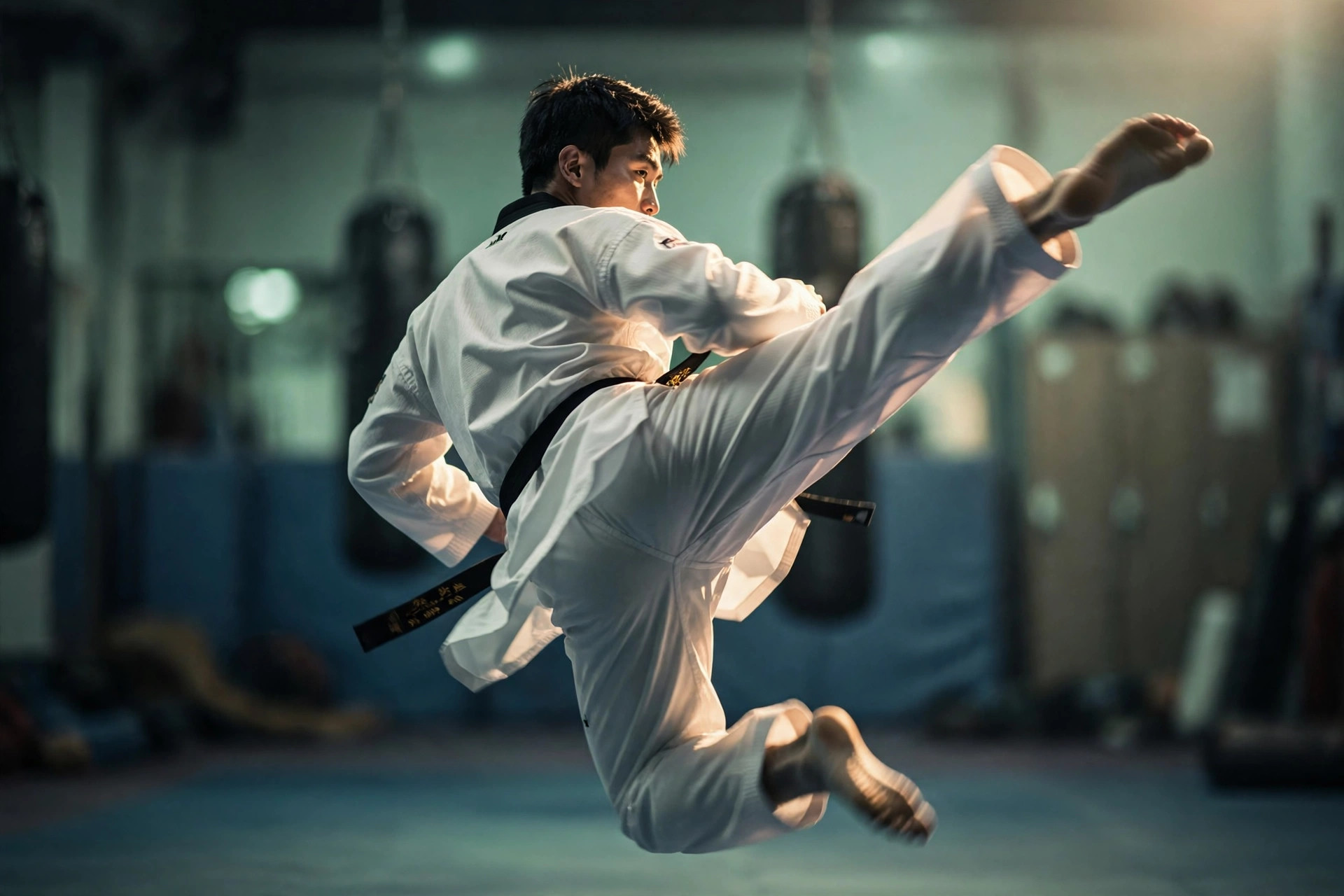
Through the second, students in wrap-front uniforms perform a pattern with no protector at all, and the instructor calls out the name Chon-Ji. Both signs say taekwondo. Both schools are telling the truth. They are also teaching two different arts that happen to share a name, a country, and about twenty years of common history. This overview maps the whole of taekwondo, both houses of it, so you can tell them apart and find your place in either one.
Section 01What Taekwondo Is
Taekwondo is a Korean striking art built around the kick. The name breaks into three parts: tae, to strike or break with the foot, kwon the fist, and do the way. Kicks come first in the name and first in the training. A developed taekwondo practitioner commands a kicking arsenal no other major art matches for depth: front, roundhouse, side, back, axe, hook, and spinning kicks, thrown standing, jumping, and in combination. Hands are not absent. Punches, knife-hand strikes, blocks, and elbow work fill the forms and the basics. But the art's identity is the leg.
There are two houses, and this article will not pretend otherwise:
- The Kukkiwon/WT house. Kukkiwon, in Seoul, is the world headquarters that certifies black belt rank. World Taekwondo (WT) is the international sport federation whose sparring, called kyorugi, is the Olympic event. Its forms are the Taegeuk poomsae. Most taekwondo schools on earth belong to this house.
- The ITF house. The International Taekwon-Do Federation, founded by General Choi Hong Hi in 1966, teaches the art as Choi codified it. Its forms are the 24 tul. Its sparring is semi-contact and continuous, with punches to the head allowed. The ITF has been split into rival organizations since 2002, which the section below covers plainly.
A third current runs alongside both: independent schools and offshoots (the ATA in the United States is the largest) that teach their own forms and ranks while calling the art taekwondo. They are part of the landscape, named here so the map is honest.
Section 02Where It Came From
Modern taekwondo is young. Korea spent 1910 to 1945 under Japanese rule, and the men who built the art trained mostly in Japanese karate during and after that period. After liberation in 1945 they opened schools called kwans, each teaching its own blend under names like Tang Soo Do and Kong Soo Do.
| Kwan | Founded | Founder |
|---|---|---|
| Chung Do Kwan | 1944 | Lee Won Kuk |
| Song Moo Kwan | 1944 | Ro Byung Jick |
| Moo Duk Kwan | 1945 | Hwang Kee |
| Chang Moo Kwan | 1946 | Yoon Byung In |
| Jidokwan (from Yun Moo Kwan) | 1946 | Chun Sang Sup |
| Oh Do Kwan | 1953 | Choi Hong Hi and Nam Tae Hi |
On April 11, 1955, a naming board settled on taekwondo as the unified name for the art. Choi Hong Hi championed the name and is widely credited with proposing it. In 1966 he founded the ITF in Seoul and took the art worldwide through demonstration teams and the Korean military diaspora. Politics then split the art. Choi fell out with the South Korean government and left the country in 1972. Korea answered by building its own headquarters: Kukkiwon opened in Seoul on November 30, 1972, and World Taekwondo (founded as the World Taekwondo Federation on May 28, 1973) carried the sport side. Taekwondo appeared as an Olympic demonstration sport at Seoul 1988 and Barcelona 1992 and became a full medal sport at Sydney 2000.
Two honesty notes belong in any history of this art. First, you will read that taekwondo descends directly from taekkyeon, the older Korean folk kicking game. Taekkyeon survived the occupation era in fragments and its influence is claimed with pride, but historians who have traced the kwan founders' actual training find the documented technique line runs through Shotokan and Shudokan karate, reshaped in Korea. Second, Choi's role is argued over in both houses. He founded the ITF and shaped the art's spread, and the Kukkiwon house built the Olympic sport after he left. The map needs both facts, not a winner.
Section 03The Two Houses Today
The WT house is a partnership of two bodies that are often confused. Kukkiwon is a Korean government-chartered headquarters. It sets the technical curriculum, runs instructor and examiner courses, and issues dan and poom certificates. Only a Kukkiwon certificate lets you enter WT international competition. World Taekwondo is the sport federation. It writes the kyorugi and poomsae competition rules, sanctions events, and holds the Olympic seat. Your local school is usually affiliated through a national association, tests its own colored belts, and sends black belt paperwork to Kukkiwon.
The ITF house is one art taught by several organizations. Choi died on June 15, 2002, in Pyongyang, and the succession dispute that followed produced three bodies that each claim the ITF name, plus smaller offshoots such as ITF HQ Korea. As of October 2026 the three principal ones are:
- The Vienna group, led by Ri Yong Son (who succeeded Chang Ung), rooted in the ITF's long-time Austrian headquarters. This group signed a protocol with WT in 2014 under which athletes may enter each other's events when they follow the host rules.
- The group led by Paul Weiler, elected after the presidencies of Tran Trieu Quan and Pablo Trajtenberg. After an Austrian court awarded the Vienna headquarters to the other group, this body moved its legal seat to Spain.
- The group led by Choi Jung Hwa, the founder's son, based in Canada.
All three teach Choi's 24 tul and his sparring rules with small variations. A dan certificate from one is not automatically honored by the others. Related: WT and ITF: The Two Taekwondos
Section 04How Training Is Organized
Both houses teach the same five components, under different Korean names and with different weight.
| Component | WT/Kukkiwon term | ITF term | What it is |
|---|---|---|---|
| Basics | Kibon | Gibon | Stances, blocks, strikes, kicks, drilled in lines and combinations |
| Forms | Poomsae | Tul | Set patterns against imagined opponents |
| Sparring | Kyorugi | Matsogi | From pre-arranged step sparring to free sparring |
| Breaking | Gyeokpa | Kyok Pa (Gyeokpa) | Boards and other materials, testing power and focus |
| Self-defense | Hosinsool | Hosin Sool | Releases, joint work, and defenses drawn from the basics |
WT training bends toward kyorugi. Class time goes to paddle drills, footwork, and the scoring game. ITF training spreads wider across patterns, step sparring, and self-defense, and its pattern performance is judged on sine wave motion, the rising and falling hip movement that Choi built into every technique.
Section 05The Forms: Two Libraries
Poomsae (WT house). The eight Taegeuk forms, one per colored-belt grade, each named for a trigram of the I Ching: Il Jang (heaven) through Pal Jang (earth). Nine dan forms follow, Koryo for 1st dan through Ilyeo for 9th. Before the Taegeuk set existed, schools practiced the eight Palgwae forms, created in the mid 1960s and replaced in the early 1970s. Palgwae still shows up in traditional schools, so it belongs on the map even though Kukkiwon no longer tests it.
Tul (ITF house). Choi designed 24 patterns, one for each hour of the day. Nine are colored-belt patterns, from Chon-Ji (heaven and earth) to Choong-Moo, and fifteen are dan patterns ending with Tong-Il, named for the hope of a reunified Korea. Most carry the names of Korean patriots, monks, kings, and generals, and the pattern meanings are test material in ITF schools. Beginners start with two four-direction exercises, Saju Jirugi and Saju Makgi, which are training drills, not counted among the 24. One name has changed over time: Ko-Dang was replaced by Juche in the early 1980s, a swap older ITF books still show.
Section 06Sparring: Two Different Sports
WT kyorugi is a full-contact kicking game scored by electronics. Fighters wear a sensor-fitted trunk protector and headgear, and most points come when a sock sensor registers a hard enough kick. Under the WT rules in force in 2026, a punch to the trunk scores 1, a kick to the trunk 2, a kick to the head 3, a turning kick to the trunk 4, and a turning kick to the head 5. Penalties (gam-jeom) hand your opponent a point, and ten of them end the match. Matches run as a best-of-three-rounds contest. Punches to the head are illegal, and the clinch game is short, which is why WT fighting looks like a fencing match fought with the legs.
ITF matsogi is continuous semi-contact. There is no trunk protector. Fighters wear hand and foot pads, a head guard, and a mouthguard, and the action does not stop when a point lands. Punches score to the head as well as the body, jumping techniques earn bonuses under the classic scoring table, and heavy contact is a foul rather than a strategy. Where WT asks "did the sensor fire," ITF asks "was it controlled, correct, and on target," judged by officials watching.
For children the two sports converge on caution. In US events under USA Taekwondo rules, there is no head contact at all for competitors aged 7 and under, and none for color belts aged 11 and under. Light, controlled head contact applies to older children and junior color belts, and full head contact is reserved for junior and senior black belts. ITF bodies likewise run children's divisions with strict contact limits. Any school that lets young children take hard head kicks in sparring is outside both houses' norms.
Section 07Ranks and Certificates
Both houses count down through geup grades (also spelled gup or kup) to 1st geup, then up through dan grades to 9th. Everything else differs.
The ITF ladder is fixed and published: white, white with a yellow tag, yellow, yellow with a green tag, and so on through red with a black tag at 1st geup. Dan holders carry titles set by Choi: assistant instructor (Boo Sabum) at 1st to 3rd dan, instructor (Sabum) at 4th to 6th, master (Sahyun) at 7th to 8th, grand master (Saseong) at 9th.
The WT house fixes the dan side and leaves the geup side to schools. Kukkiwon sets time and age minimums for every dan (1st dan at 15 or older, and the waits grow to nine years before 9th dan) and issues the certificates. Children under 15 earn poom grades instead of dan, four of them, which convert to the matching dan when the holder comes of age. Colored-belt colors and order are each school's choice, so a green belt at one WT school is not the same grade as a green belt at another. Only the geup number travels.
Section 08Breaking, Self-Defense, and the Rest of the Map
Breaking (gyeokpa) is a graded skill in both houses. Kukkiwon dan tests include breaking, WT runs breaking events at festivals such as the Hanmadang, and ITF championships include two breaking disciplines: power breaking, stacking boards for hand and foot techniques, and special technique, flying breaks at height and distance. Self-defense lines run through both curricula, drawn from the basics and the forms' applications. Demonstration teams, a Korean taekwondo institution of their own, combine forms, breaking, and acrobatic kicking, and Kukkiwon and university teams tour worldwide. Para taekwondo, WT's kyorugi and poomsae for athletes with disabilities, joined the Paralympic program at Tokyo 2020. A map of the art that stops at Olympic sparring leaves all of this out.
Section 09The Culture in the Room
Classes open and close with bows: to the flag, to the instructor, to each other. Commands run in Korean in most schools worldwide, and students count kicks in Korean, in one of two counting systems. ITF schools recite Choi's five tenets (courtesy, integrity, perseverance, self-control, indomitable spirit) and the student oath that follows them, and many WT schools have adopted the same tenets. The uniform is the dobok. WT schools wear the pullover V-neck style. ITF schools wear a wrap-front dobok, and ITF black belts add black trim. Small details, but they are how you read a room in the first ten seconds.
Section 10Common Mistakes
- Assuming the two houses are one art with two spellings. They share grandparents and a name. Forms, sparring, and certificates are separate, and rank does not cross over automatically.
- Calling WT "taekwondo" and ITF something else. WT governs a sport. Kukkiwon certifies the art's rank in that house. The ITF is not a knockoff of either.
- Trusting belt colors across schools. In the WT house the colors are local. Ask for the geup number.
- Believing the ancient-lineage marketing. The documented founders learned karate in Japan and built something Korean out of it in the 1940s and 1950s. That is a strong enough story without dressing it in two thousand years.
- Judging a school by its house. Both houses contain excellent and poor schools. The instructor in front of you matters more than the flag on the wall.
Section 11The Companion Guide
The companion to this article is the Taekwondo Quick Reference. It packs the working data of both houses into one printable: the full Taegeuk and dan poomsae tables with movement counts and trigram meanings, all 24 ITF tul with their meanings and counts, a kick catalog with Korean names from both houses, both belt ladders, the Kukkiwon dan minimums, WT and ITF scoring tables, weight classes, dojang commands, both counting systems, the tenets and oath, and a breaking reference. The article gives you the knowledge. The guide is the sheet you keep in your gear bag.
- Taekwondo is one name over two houses: the Kukkiwon/WT house of Olympic sport, and the ITF house of Choi Hong Hi's Taekwon-Do, itself now taught by several rival organizations.
- The art was built in the 1940s and 1950s by kwan founders trained largely in Japanese karate, named in 1955, and split by politics in the early 1970s.
- Forms divide cleanly: Taegeuk poomsae and nine dan poomsae in one house, 24 tul in the other.
- Sparring divides just as cleanly: electronic full-contact kyorugi with no head punches, versus continuous semi-contact matsogi where punches to the head score.
- Rank is geup then dan in both houses, but only Kukkiwon certifies WT-house black belts, children there earn poom, and belt colors in WT schools are local, not universal.
Related: Taekwondo: A Beginner's First Three Months Related: WT and ITF: The Two Taekwondos Related: Shotokan Karate: An Instructor's Overview