
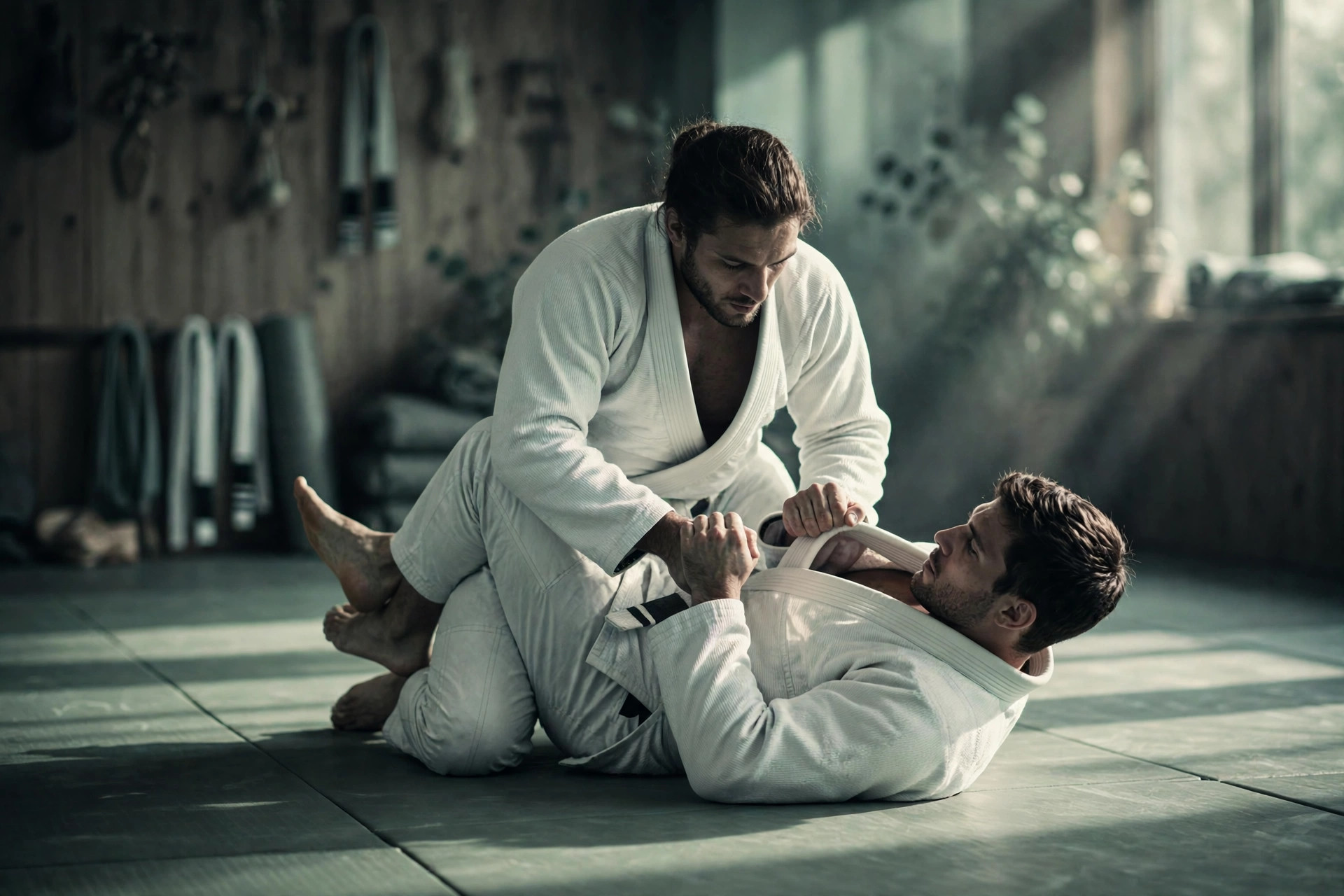
You push. Nothing moves. You push harder, arms shaking, lungs burning, and he calmly slides a hand inside your collar. You tap to a choke you never saw coming, sit up gasping, and ask the question every beginner asks: how is that possible? The answer isn't strength, and it isn't a trick. It's a system. This guide is that system, explained whole.
Brazilian jiu-jitsu (BJJ) is a grappling art built on one simple observation: most fights that go to the ground are won by the person who understands position, leverage, and timing, not the person who is bigger or stronger. On the mat, a smaller practitioner routinely controls and submits a larger one, not through magic, but through mechanics. If you have ever watched a BJJ match and wondered how the person on the bottom could possibly be winning, this guide is your starting point.
This article surveys the whole art: where it came from, the ideas that organize it, how training actually works, and what to expect if you step on the mat yourself.
Section 01What Brazilian Jiu-Jitsu Is
BJJ is a ground-fighting art. Its goal is to take the fight to the ground, establish a dominant position, and finish with a submission, a choke or a joint lock that forces your opponent to tap out, signaling surrender. There are no strikes in sport BJJ. The entire game is gripping, positioning, escaping, and finishing.
What makes BJJ distinct from other grappling arts is its emphasis on fighting from the bottom. In most wrestling traditions, being on your back means you are losing. In BJJ, the person on the bottom wraps their legs around the opponent in what is called the guard, and from there, they can sweep, reverse the position, or submit. That single idea, that the bottom can be an attacking position, reshaped modern grappling.
Section 02Where It Came From
BJJ descends directly from Kodokan Judo. In the early 1900s, Mitsuyo Maeda, a judo expert and prizefighter trained at the Kodokan in Japan, traveled the world demonstrating and teaching judo. In 1914 he arrived in Brazil, where he taught the art to the Gracie family, most notably Carlos Gracie and, later, Carlos's younger brother Hélio.
The Gracies adapted what they learned. Hélio, who was smaller and frailer than his brothers, modified the techniques to rely more on leverage and timing than on strength and explosiveness. The family tested their art relentlessly in challenge matches against boxers, wrestlers, capoeiristas, and other martial artists, and they refined it in public for decades.
The art's global breakthrough came in 1993, when Royce Gracie, not the biggest man in the tournament, won the first Ultimate Fighting Championship by submitting larger opponents on the ground. The UFC era changed martial arts forever: striking arts had to learn grappling or get taken down, and BJJ gyms spread worldwide. The art Maeda carried out of the Kodokan now has its own worldwide federations, professional events, and millions of practitioners. Related: Kodokan Judo: An Instructor's Overview
Section 03The Positional Hierarchy
BJJ is organized around a hierarchy of positions, from worst to best. Understanding it explains nearly every decision a practitioner makes.
At the bottom of the hierarchy, your opponent is mounted on your chest or controlling your back with hooks in. Above that, you are under side control, pinned, chest to chest. Then come the neutral and transitional positions: half guard, guard, and the scramble. At the top are the dominant positions: knee on belly, mount, and back control with both hooks, generally considered the most dominant spot in the art, because you can attack while your opponent cannot easily attack back.
| Rank | Position | The situation |
|---|---|---|
| 1 | Back control (both hooks in) | You attack the neck and arms. Your opponent can only defend |
| 2 | Mount | Your weight rides their chest and gravity works for you. They carry you with every breath |
| 3 | Knee on belly | Heavy, mobile pressure. One step from mount, hard to hold but exhausting to be under |
| 4 | Side control | Chest-to-chest pin. Their arms become targets and their escapes cost energy |
| 5 | Top of half guard | A passing position: you're winning, but one leg is still trapped |
| 6 | Guard (closed or open) | The bottom player's weapon. Sweeps and submissions live here. The top player must pass |
| 7 | Bottom of half guard | You're underneath, but a trapped leg gives you leverage to work back to guard |
| 8 | Under side control | Pinned. Framing and escaping are everything |
| 9 | Mounted | Their weight and gravity against you. Escape before they settle |
| 10 | Back taken on you | The worst seat in the house: protect your neck, clear a hook, turn in |
Coaches argue about the middle of this table. Some rank knee on belly above side control, others below it, and where the guard sits depends entirely on the guard player's skill. The extremes are universal: back control is the summit, and having your back taken is the floor.
The logic is practical. From a dominant position, you are safe and your opponent is in danger. From an inferior position, you are in danger even if nothing hurts yet. So the first skill in BJJ is not submitting people. It is climbing the hierarchy: escaping bad positions, improving to neutral ones, and advancing to dominant ones before you ever think about a finish. Position before submission is the oldest coaching cue in the art, and it is still the truest.
Three more pieces of the map sit outside that ladder, and a complete picture needs them. Every match starts standing: the opening battle is takedown versus guard pull, and it decides who begins the ground game on top. The turtle, balled up on hands and knees, is the art's defensive shell: a poor place to live, but a real position with its own escapes and reversals, and its own attacks (back takes, chokes) for the player on top. North-south, the head-to-toe pin, folds into the ladder at the side-control rung. And the modern leg-entanglement family runs on a parallel track: positions like 50/50 guard, outside ashi garami, and the saddle (cross ashi, often called the honey hole) exist to isolate a leg for the heel hook and straight ankle lock, and attacks flow both ways inside them, which is why coaches rank them separately from the pin ladder rather than forcing them onto it.
Section 04The Guard: BJJ's Defining Idea
The guard is what separates BJJ from every other grappling system. When you are on your back and wrap your legs around your opponent's body (closed guard), hips (open guard variations), or legs, you are not losing. You are holding a weapon. From the guard you can:
- Sweep: off-balance your opponent and come out on top
- Submit: attack chokes and armlocks using your legs as the engine
- Control: break your opponent's posture and dictate the pace
Guards have multiplied into whole families: closed guard, half guard, butterfly guard, De La Riva, spider guard, lapel guards, and more. Each is a small system of grips, angles, and attacks. The top player, meanwhile, works to pass the guard, to get around the legs into side control or mount. Guard passing versus guard retention is the central chess match of the art.
Section 05Submissions — and the Safety Culture Around Them
Submissions fall into two broad categories:
Chokes (strangles). Techniques that compress the carotid arteries on the sides of the neck (blood chokes) or the airway. Blood chokes can render a person unconscious in seconds if held, which is exactly why they are released the instant a partner taps.
Joint locks. Armbars attack the elbow. Kimuras, americanas, and omoplatas attack the shoulder. Leglocks attack the knee and ankle, each hyperextending or rotating a joint beyond its safe range.
Two more categories complete the map. Spinal locks, the twister and neck cranks, attack the spine rather than a limb. They are banned outright under IBJJF rules and appear only in some advanced divisions of other rulesets. Compression locks (bicep and calf slicers) and wrist locks round out the list: real, commonly taught techniques that many rulesets also restrict by belt level. If a technique exists, it belongs on the map. Whether you may use it depends on your belt and the rulebook in front of you.
Here is the part that matters most, and it is non-negotiable in this art: you tap early and you tap often, and your partner stops the instant you tap. A submission is applied with control, increasing pressure gradually, giving your partner time to concede. Nobody "cranks" a submission in training. The tap is not a defeat to be ashamed of. It is the mechanism that lets two people practice genuinely dangerous techniques, at full resistance, thousands of times, and walk off the mat healthy. Every BJJ school worth training at treats this as sacred. If you visit a gym where upper belts crank submissions or ignore taps, leave.
Lower-body submissions deserve a special note: heel hooks and other rotating leglocks can injure a knee before pain registers, so most schools restrict them for beginners and teach them as knowledge and control first. That progression, control before submission, always, is how the art stays safe enough to train for a lifetime.
Section 06Gi and No-Gi
BJJ is trained in two formats. In gi training, you wear the traditional heavy cotton uniform, and the jacket, collar, sleeves, and belt all become grips, for you and against you. Gi training tends to be a little slower and more grip-dependent, with techniques like collar chokes and lapel guards that exist only because the clothing does.
In no-gi, you wear shorts and a rash guard. There is nothing to grab on the torso, so control comes from underhooks, overhooks, and wrestling-style ties. The pace is faster, escapes are slipperier, and leglocks feature more prominently in modern no-gi competition.
Most schools teach both, and most techniques transfer. Related: Gi vs No-Gi: Which Should You Train?
Section 07The Belt System
Adults in BJJ progress through five belt colors: white, blue, purple, brown, and black. The table below shows the typical time spent at each belt for a student training consistently two to three times per week. These are averages, not promises. Competition success, training frequency, and prior grappling experience all move the timeline.
| Belt | Typical time at belt | Rough total time | What it usually means |
|---|---|---|---|
| White | 1–2 years | — | Survival: escapes, core positions, not panicking under pressure |
| Blue | 2–3 years | 3–5 years | A working guard, reliable escapes, the beginnings of real offense |
| Purple | 1.5–3 years | 5–8 years | A personal game: attacks chained into systems, not single moves |
| Brown | 1–2 years | 7–10 years | Refinement and pressure, often helping to teach |
| Black | — | About a decade | Depth and detail, widely treated as a new beginning, not an end |
That puts black belt at around ten years for most people who stick with it. And the slowness is the point. A BJJ belt is widely trusted precisely because it cannot be bought or rushed.
Black belt is graded too. Degrees on a black belt are earned over further decades of training and teaching, and at the highest grades the belt itself changes: the 7th degree wears the red-and-black coral belt, the 8th degree the red-and-white coral belt, and the 9th and 10th degrees a solid red belt, ranks a handful of living practitioners hold.
Between belts, many instructors award up to four stripes on the belt to mark progress. But stripes are a school custom, not a universal rule, and plenty of academies don't use them. Promotion itself is entirely at the instructor's discretion at most schools. There is no standardized test. The IBJJF does publish minimum times at belt (and a minimum age of 16 for blue belt) that govern competition eligibility and recognized promotions, but your school's standards are what actually decide your belt. Children use a separate, more granular belt ladder (white through gray, yellow, orange, and green) before joining the adult ranks at sixteen.
Section 08How a Class Is Structured
A typical class runs 60 to 90 minutes and follows a pattern you will recognize after your first week:
- Warm-up: jogging, hip escapes (shrimping), breakfalls, and movement drills
- Technique: the instructor demonstrates one or two techniques or a short sequence, and you drill them with a partner at cooperative resistance
- Positional sparring: live rounds starting from the position of the day, with a specific goal
- Rolling: free sparring rounds, usually five to ten minutes each, where you try to apply everything against full resistance
You will not be thrown into rolling on day one at most schools. And if free sparring starts quickly, you are always allowed to decline a round or ask a partner to go light. Related: BJJ for Beginners: Your First 6 Months on the Mat
Section 09Sport BJJ vs. Its Self-Defense Roots
Modern BJJ is primarily a sport, with rulesets that award points for takedowns, guard passes, sweeps, and dominant positions, and victory by submission or points. Sport strategy sometimes pulls players toward positions that make sense under a rulebook.
The art's roots, though, are in self-defense and vale tudo (no-holds-barred) fighting, and most schools still teach the fundamentals with that in mind: managing distance, avoiding strikes while closing in, clinching, taking the fight down, and escaping bad spots. You will hear spirited arguments about how much the sport game has drifted from its fighting origins. The honest answer is that the foundational skills, positional control, escapes, and submissions, work in both worlds, and the specialized sport techniques are a layer on top of that foundation, not a replacement for it.
Rulesets also differ from each other in ways that change the game: IBJJF matches are won on points or submission, with heel hooks banned and several leglocks restricted by belt. Submission-only and ADCC-style events remove points or score them differently and allow more of the leg game at advanced levels. Always check the rulebook of the event in front of you.
Section 10Who It's For and What You Need
BJJ is for almost anyone. You do not need to be in shape to start. Starting is how you get in shape. You do not need a wrestling background, flexibility, or youth. Adult beginner classes are full of people in their thirties, forties, and beyond, and the art's leverage-based design is specifically kind to smaller and older practitioners.
To start, you need a gi (many schools lend or sell one), trimmed nails, and a willingness to be bad at something for a while. Everyone is. The learning curve is steep for the first few months and then deeply rewarding. BJJ has a way of becoming the thing people train for decades.
Section 11Where Beginners Go Wrong
- Trying to bench-press people off. Pushing straight up from under mount or side control burns your energy and extends your arms straight into armbars. Escapes come from frames, bridges, and hip movement, not pushing.
- Holding your breath and redlining every round. Beginners roll at 100% until they gas, then can't think. Pace you can sustain is pace you can learn at.
- Chasing submissions from bad positions. The armbar attempt from inside someone's guard, the choke from under mount. Attacks launched while you're losing position usually just finish the job for your opponent.
- Death-gripping the gi. White-knuckled grips feel like control and mostly destroy your forearms by the second round. Grip with purpose, release and re-grip.
- Refusing to tap to someone smaller or newer. Ego is the most common injury mechanism in BJJ. The tap protects your joints. Use it before you need it.
- Comparing timelines. The ex-wrestler who started the same month as you is not your measuring stick. Belts take the time they take.
Section 12The Companion Guide
This article gives you the knowledge, the whole art on one page. The companion guide turns it into a reference you train with: the BJJ Position Map & Beginner Reference.
It contains the positional hierarchy as a single chart, the seven core positions with the primary attacks and primary escapes for each, a per-position annex with deeper attack and escape lists and the counter to watch for in each spot, a catalog of thirteen guards, the submission categories with the safety rule that governs each one, a rules annex with the IBJJF legality chart, the penalty ladder, and IBJJF and ADCC weight classes, a positional drilling library of ten games, the complete belt ladder with average timelines, and a mat-etiquette checklist you can run through before every class. Print it, keep it in your gym bag, and use it to decode what your instructor is describing until the positions are second nature. It's written for new students in their first months, the people still learning to see the map while they're underneath it.
- BJJ is a ground-fighting art: position first, then submission, with the guard making the bottom an attacking position
- It descends from Kodokan Judo through Mitsuyo Maeda and the Gracie family, and reached the world through the UFC
- The positional hierarchy, escape, improve, advance, submit, organizes every decision on the mat
- Safety culture is non-negotiable: tap early and often, apply submissions with control, never crank
- It trains in gi and no-gi formats, and belts run white to black over roughly a decade of consistent training
- You don't need to be fit, young, or experienced to start, just consistent