
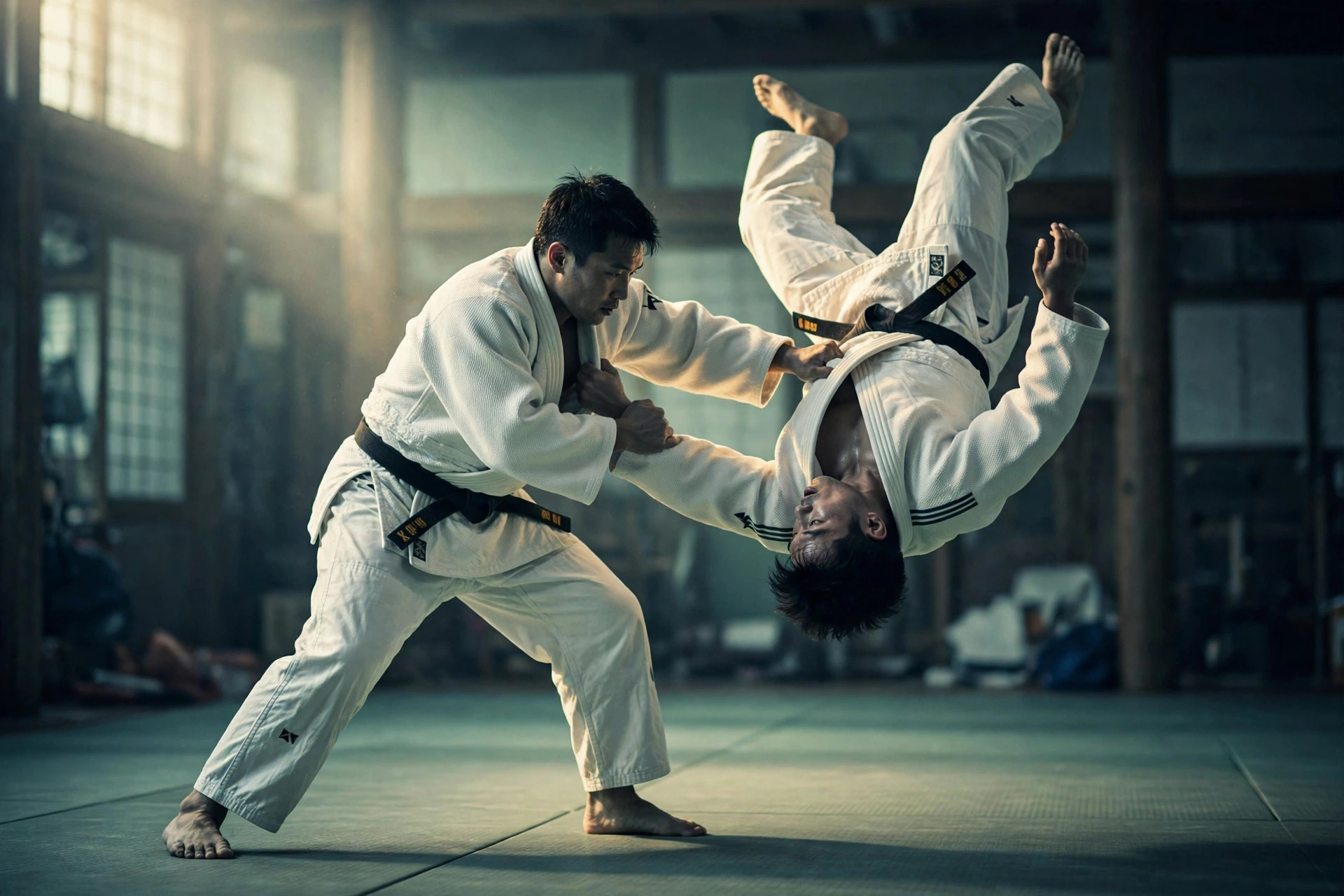
A breath later he is flat on his back, the slap of his breakfall echoing off the walls, getting up laughing and completely unhurt. She didn't outmuscle him. She barely seemed to move. His balance went, his own momentum did the rest, and the fall that should have hurt was the safest part of the exchange. That single moment contains the whole art. This guide is the map of it.
Judo is the art of throwing someone larger than you without hitting them, and of landing safely when someone does the same to you. It was created in Japan in 1882 by Jigoro Kano, who stripped the dangerous techniques out of classical jujutsu and rebuilt what remained into a system of physical education, self-defense, and personal development. Today it is practiced in nearly every country on earth, contested at the Olympic Games, and still taught in its original form at the Kodokan in Tokyo, the institute Kano founded.
If you're thinking about starting, or you've started and want the full map of what you're learning, this guide is that map.
Section 01What Judo Is
The word judo is written with two characters: ju, meaning gentleness or yielding, and do, meaning way or path. The name is the method. Instead of meeting force with force, a judoka uses an opponent's balance, momentum, and commitment against them. A throw succeeds not because you overpowered someone, but because you were in the right place at the right moment with the right mechanics while they were off balance.
Judo is a grappling art. There are no strikes in judo's free practice or competition, though striking does exist in the wider art, preserved in the kata, as the technique map below explains. A contest is won by throwing your opponent cleanly onto their back, by pinning them, or, for older teens and adults, by a choke or armlock that forces a submission. Training happens on tatami mats in a uniform called a judogi, and almost everything you learn rests on two foundations: how to fall, and how to move.
Section 02The Two Principles
Kano built judo on two principles, and they govern everything from technique to how you treat your training partners.
Seiryoku Zenyo: maximum efficiency, minimum effort. Use your energy well. In practice this means leverage over muscle: a well-timed foot sweep needs almost no strength, while a forced throw against a balanced opponent fails no matter how strong you are. Kano intended the principle to apply off the mat as well, in study, work, and daily decisions.
Jita Kyoei: mutual welfare and benefit. You cannot progress in judo alone. Every throw you practice requires a partner who lets you throw them, and every partner you throw must be kept safe enough to train again tomorrow. Progress is shared or it doesn't happen. This is why etiquette in judo is not decoration. It's structural.
Section 03The Techniques: Waza
Judo techniques are called waza, and the Kodokan classifies them into three families. The first two are what you practice live, against resistance, every class. The third survives only in the formal kata, and a complete map of judo has to show all three.
Nage-waza: Throwing Techniques
Throws are classified by the part of the body that does the main work:
- Te-waza (hand techniques). The hands and arms drive the throw, as in seoi nage (shoulder throw) and tai otoshi (body drop).
- Koshi-waza (hip techniques). The hip acts as the fulcrum, as in o goshi (major hip throw) and harai goshi (sweeping hip throw).
- Ashi-waza (foot and leg techniques). Timing-based sweeps and reaps, as in de ashi harai (advanced foot sweep), ouchi gari (major inner reap), and osoto gari (major outer reap).
- Sutemi-waza (sacrifice techniques). You throw your own body to the mat to power the throw, as in tomoe nage (circle throw). These are subdivided into throws where you fall straight back (ma-sutemi) and throws where you fall to the side (yoko-sutemi).
Katame-waza: Grappling Techniques
Once on the ground, the grappling family takes over:
- Osaekomi-waza (pinning). Holding your opponent on their back under control for a set time to score.
- Shime-waza (strangles and chokes). Applied to the neck with the arms or the judogi collar. Taught only to older students under supervision, and always with the rule that you tap early and release instantly.
- Kansetsu-waza (joint locks). In judo, these target the elbow only, as in juji gatame (cross armlock). Restricting joint locks to one joint is one of Kano's safety decisions that makes free practice possible.
Competition rules layer further restrictions on top: shime-waza and kansetsu-waza are not permitted for children, and most rule sets unlock them by age group, chokes first and armlocks later (under IJF rules, for example, cadets may use shime-waza but not kansetsu-waza). The techniques are in the art. Who may use them, and when, is deliberately gated.
Atemi-waza: The Striking Techniques
Judo does contain strikes: punches, kicks, and strikes with the hand, elbow, knee, and foot, aimed at vital points. What it does not contain is live striking: atemi-waza were excluded from randori and from competition from the beginning, because you cannot safely practice full-power strikes against a resisting partner. Instead they were preserved inside the kata. Kime no Kata and Kodokan Goshin Jutsu include strikes, and defenses against them, in fixed form. So the honest map reads: judo is a grappling art in practice, with a striking syllabus kept in trust by its forms. Anyone who tells you "judo has no strikes" is describing the contest, not the whole art.
Section 04Ukemi: The Safety Foundation
Before any of the above, there is ukemi, the art of falling. Beginners learn back falls, side falls, forward falls, and forward rolls before they are thrown, and they will use ukemi in every single class for the rest of their judo lives.
Ukemi works by spreading impact across a large surface of the body, keeping the head tucked and protected, and converting a fall into a roll or a slap-out rather than a stop. It is unglamorous, repetitive, and the single most useful thing judo teaches. Most people who train will use a breakfall on ice, on stairs, or off a bicycle long before they ever throw anyone outside the dojo.
Section 05Randori and Kata: Two Ways to Train
Judo training has two classic modes, and Kano designed them to balance each other.
Randori is free practice, sparring. You and a partner grip up and try to throw each other with full technique but controlled force, while each defends and counters. Randori is where timing, grip fighting, and composure under pressure are built. It is not a fight to exhaustion. Good randori is hard, technical, and cooperative in spirit even when it's competitive in fact.
Kata are pre-arranged forms, fixed sequences performed with a partner to preserve the principles and details behind the techniques. Kodokan judo has a formal set of them, and a map of the art should name them, because kata are where everything excluded from free practice is kept:
- Nage no Kata. The forms of throwing: fifteen throws, three from each family, shown exactly as they are meant to work. The kata most students meet first.
- Katame no Kata. The forms of grappling: fifteen pins, chokes, and armlocks, the ground counterpart to Nage no Kata.
- Kime no Kata. The forms of decision: serious self-defense against unarmed and weapon attacks, including the striking techniques (atemi-waza) that randori excludes.
- Kodokan Goshin Jutsu. Kano's modern self-defense forms (formalized in 1956, after his death): twenty-one defenses against holds, strikes, and weapons, the contemporary companion to Kime no Kata.
- Ju no Kata. The forms of gentleness: slow, flowing movements that teach yielding, balance, and the ju principle itself, performed without a judogi's full gripping battle.
- Itsutsu no Kata. The forms of five: five unnamed movements expressing judo's deepest principles, left deliberately abstract. Kano never named the techniques.
- Koshiki no Kata. The antique forms: preserved from Kito-ryu jujutsu, the school Kano trained in, kept as a direct link to judo's battlefield ancestry.
- Seiryoku Zenyo Kokumin Taiiku. The national physical exercise form built on maximum efficiency. Its solo exercises are where many of judo's strikes are practiced alone.
Kata looks slow next to randori, but it is where precision lives, and where the "missing" parts of judo, the strikes and the self-defense syllabus, actually reside.
Most classes mix both, along with uchikomi, repeated entries into a throw without completing it, which builds the movement patterns that make throws automatic.
Section 06The Gokyo: The Throwing Syllabus
In 1895 Kano organized forty core throws into five groups of eight, the Gokyo no Waza. The grouping is a teaching progression, roughly ordered so that each set builds the balance, footwork, and falling confidence the next set demands. The first group (Dai Ikkyo) includes throws like de ashi harai, o goshi, and seoi nage. Later groups introduce the more dynamic hip throws, sacrifice throws, and counters. Here is the syllabus complete:
| Group | Throws |
|---|---|
| Dai Ikkyo (1st group) | De-ashi-harai · Hiza-guruma · Sasae-tsurikomi-ashi · Uki-goshi · O-soto-gari · O-goshi · O-uchi-gari · Seoi-nage |
| Dai Nikyo (2nd group) | Ko-soto-gari · Ko-uchi-gari · Koshi-guruma · Tsurikomi-goshi · Okuri-ashi-harai · Tai-otoshi · Harai-goshi · Uchi-mata |
| Dai Sankyo (3rd group) | Ko-soto-gake · Tsuri-goshi · Yoko-otoshi · Ashi-guruma · Hane-goshi · Harai-tsurikomi-ashi · Tomoe-nage · Kata-guruma |
| Dai Yonkyo (4th group) | Sumi-gaeshi · Tani-otoshi · Hane-makikomi · Sukui-nage · Utsuri-goshi · O-guruma · Soto-makikomi · Uki-otoshi |
| Dai Gokyo (5th group) | O-soto-guruma · Uki-waza · Yoko-wakare · Yoko-guruma · Ushiro-goshi · Ura-nage · Sumi-otoshi · Yoko-gake |
The Gokyo was revised in 1920, and keeping the layers straight matters, because three different numbers get confused for each other. The Gokyo itself is the teaching canon: forty throws. The Kodokan's full recognized catalog is larger, 67 throws, made up of the Gokyo's forty, eight older techniques the Kodokan keeps recognized but outside the teaching syllabus (habukareta waza, "discarded techniques"), and further throws officially added since. And what you may actually use in a modern contest is a third, smaller set, because competition rules filter the catalog: under current IJF rules, grabbing the legs with the hands is prohibited, which removes morote gari and the leg-grabbing entries into kata guruma and kibisu gaeshi from shiai even though all three remain in the Kodokan's list. A few recognized techniques are prohibited outright in competition for safety: kani basami (the scissors throw), do-jime (trunk scissors), and kawazu gake among them. They are still part of the art's catalog. They are simply not part of the contest. The Gokyo remains the backbone of how judo is taught nearly everywhere: if you learn to a solid standard through the five groups, you know judo's throwing game.
Section 07Belts: The Kyu and Dan Structure
Kano also invented the ranking structure that most martial arts now copy. Students begin in the kyu grades, which count down toward black belt, wearing colored belts that vary by country and federation, commonly white, yellow, orange, green, blue, and brown in many Western systems. After that come the dan grades, which count up from 1st dan (shodan). Higher dan grades are awarded for competitive record, teaching, and contribution to the art, not just personal skill. Children's grades often use more colors, or split grades, than the adult sequence. A club full of nine-year-olds needs more milestones than six belts provide. At the very top of the ladder, the belt changes again: in the Kodokan and many federations, 6th through 8th dan wear the kohaku belt of alternating red and white panels, and 9th and 10th dan a solid red belt. Not every federation follows this. Some high grades simply keep a black belt. But if you ever see a red-and-white belt on the mat, you are looking at a lifetime in the art.
Two things worth knowing: belt colors and the exact order differ between countries and organizations, so a belt's color means less than the knowledge behind it, and promotion in traditional judo weighs time in grade, technical knowledge, and conduct, not just winning.
Standards vary by federation, too. The Kodokan promotes dan grades under its own rules in Japan, while national federations, USA Judo and the USJF/USJA in the United States, the British Judo Association in the UK, and their counterparts elsewhere, publish their own kyu syllabi and exam requirements. The same grade can therefore ask for a slightly different set of techniques in different countries, even though the art underneath is the same.
Section 08Judo as an Olympic Sport
Judo became the first Asian martial art in the Olympic Games at Tokyo in 1964, where Kano's art was contested in the city he had spent his life teaching in, though Kano himself did not live to see it, having died in 1938. Women's judo joined as a demonstration event in 1988 and a full medal event in 1992. Under the International Judo Federation, sport judo has its own rule set that evolves over time, rewarding clean, decisive throws (ippon) and penalizing passivity.
It's worth understanding that sport judo and Kodokan judo are the same art at different emphases: the sport is a test, not the whole syllabus. Many dojos train students who never compete, and the techniques, kata, and self-defense applications continue regardless of what the current competition rules reward.
Section 09Who Judo Is For, and What Beginners Need
Judo suits people who want a grappling art with a deep technical system, a strong safety culture, and live practice against resisting partners from early on. It develops balance, coordination, falling skills, and physical confidence that transfers well into everyday life and into other grappling arts. Training is physically honest. Randori will tell you the truth about your fitness. But classes scale: children, older adults, recreational players, and international competitors all train the same art at different intensities.
To start, you need very little:
- A judogi. The heavy woven jacket, pants, and belt. Many schools lend or sell one. Buy a judo gi rather than a lighter karate uniform, because the jacket has to survive gripping and throwing.
- Trimmed nails and no jewelry. A safety and etiquette standard everywhere.
- A willingness to fall. Repeatedly, on purpose, until it stops being scary. That is the real first month of judo. Related: Judo for Beginners: Your First Month on the Mat
You do not need to be fit before you start. Fitness is an output of training, not an entry requirement.
Section 10Common Mistakes Beginners Make
- Muscling the throw. If your arms are doing the heavy work, kuzushi never happened. Throws are set up by balance and finished by position, not by pulling harder.
- Stiff arms in randori. Locked, straight arms keep a partner at a distance, but they also freeze your own attacks and telegraph everything. Bent, relaxed arms move. Stiff arms just push.
- Bracing when thrown. Tensing up and reaching for the floor is the exact instinct ukemi exists to replace. A relaxed body that slaps and rolls lands softer than a rigid one, every time.
- Skipping ukemi practice. Once the throws start, beginners stop drilling falls. Don't. Falling skill is what lets you train hard for decades instead of months.
- Death-gripping the gi. A maximum grip burns out your forearms and dulls your feel for a partner's movement. Hold firmly, not desperately. You'll last longer and learn faster.
- Collecting throws. Fifteen throws performed badly are worth less than five performed well. The Gokyo is ordered as a progression for a reason: depth before breadth.
Section 11The Companion Guide
This article gives you the knowledge. The companion guide is the version you train with. Judo Quick Reference: Principles, Waza & the Gokyo condenses everything above into a printable reference: the two principles, the complete Gokyo table with all forty throws, the waza family tree, contest scoring at a glance, the belt ladder, and a glossary of the core Japanese terms you'll hear called out on the mat. It goes further than this article does. The full table of all 67 Kodokan throws is there, with each throw's contest status marked. So is a kata annex listing what is inside each of the eight kata, a contest rules annex with the shido and hansoku-make lists and the IJF weight classes, and a practice annex that structures uchikomi, nagekomi, and randori by Gokyo group. It's for beginners who want to check a term, find a throw's group, or decode a score without re-reading a full article. Keep it in your gym bag or near the mat, and it stays useful long after your first month.
- Judo was founded by Jigoro Kano at the Kodokan in Tokyo in 1882, refined from classical jujutsu into a system built for safe, lifelong practice.
- Its two principles, Seiryoku Zenyo (maximum efficiency, minimum effort) and Jita Kyoei (mutual welfare and benefit), govern both technique and behavior.
- Techniques divide into nage-waza (throws: hand, hip, foot/leg, and sacrifice), katame-waza (pins, chokes, and elbow locks), and atemi-waza (strikes, preserved in kata, never used in free practice).
- Judo's kata set, Nage no Kata through Koshiki no Kata and Kodokan Goshin Jutsu, keeps the complete art, including the self-defense and striking syllabus that competition excludes.
- Ukemi, the art of falling safely, comes before everything and remains the most practically useful skill judo teaches.
- Training balances randori (free practice) with kata (formal sequences), organized around the Gokyo syllabus of core throws.
- The kyu/dan belt structure Kano created now underpins ranking in martial arts worldwide.
- Judo has been an Olympic sport since the 1964 Tokyo Games.
- Beginners need only a judogi, trimmed nails, and patience. The first job is learning to fall.